
Review · OSTIA ANTICA TOURS
Ostia Antica Semi Private Tour from Rome
Ostia Antica lets you walk through the bones of a Roman city without making the long journey to Pompeii. Its streets lead past baths, bakeries, market stalls, homes, and public toilets, while a guide helps you picture how this port city worked. The site is large and easy to misread on your own, so a guided visit can make the ruins feel like a place rather than a collection of old stones.
I like two things in particular: the small group of 12 or fewer, which leaves room for questions, and the train ride from Rome, which avoids road traffic and keeps the outing manageable. Guides such as Rebecca, Sonia, and Camille have been praised for bringing the city’s architecture and daily life into focus.
The main consideration is the walking. Ostia Antica covers a broad area, with uneven ground and limited access for visitors with mobility concerns. You’ll also need to pay separately for the train and bring your own water and snacks.
- A Roman city, not a single monument: Explore streets, baths, shops, homes, temples, and other remains spread across a large site.
- A guide makes the ruins easier to read: Guides including Sonia, Rebecca, and Camille have backgrounds in history, archaeology, architecture, or conservation.
- Small group by design: The group is capped at 12, making it easier to ask questions and keep a personal pace.
- Train fare is extra: The guide helps you buy tickets at Piramide station. The stated round-trip cost is €3 per person.
- Entry is included: Your tour price covers Ostia Antica admission and skip-the-line access.
- Plan for a half-day outdoors: The tour lasts about four and a half hours, with a restroom and snack break during the visit.
Ostia Antica gives Roman daily life room to show
Rome’s grand monuments can make ancient history feel like a parade of emperors, marble facades, and big public gestures. Ostia Antica offers a different view: a city where you can trace the ordinary spaces that helped Roman life run, from bakeries and shops to baths and shared toilets.
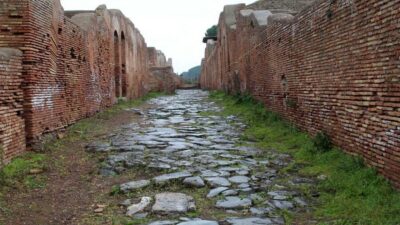
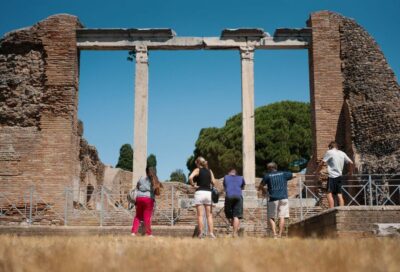
The site is an ancient port city, and its scale is part of the appeal. You don’t just stop at one famous building, take a photo, and move on. You walk through a broad archaeological area where streets, structures, and public spaces help you imagine how a working Roman town was laid out.
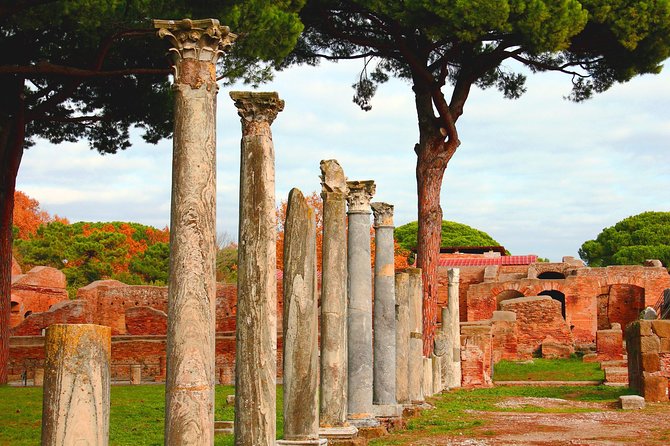
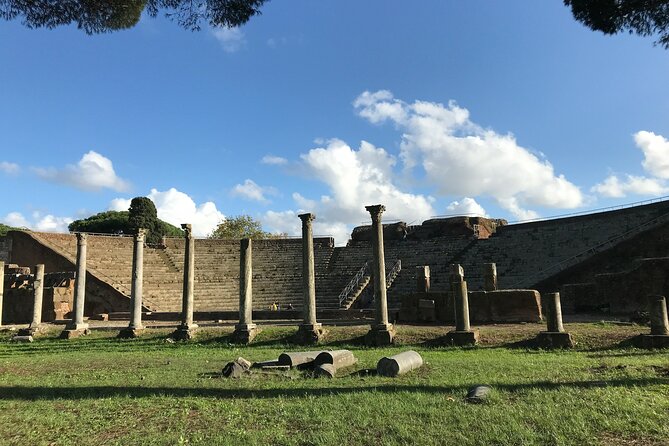
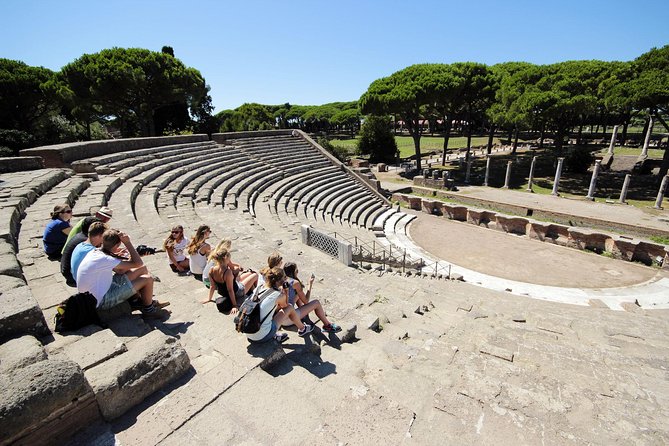
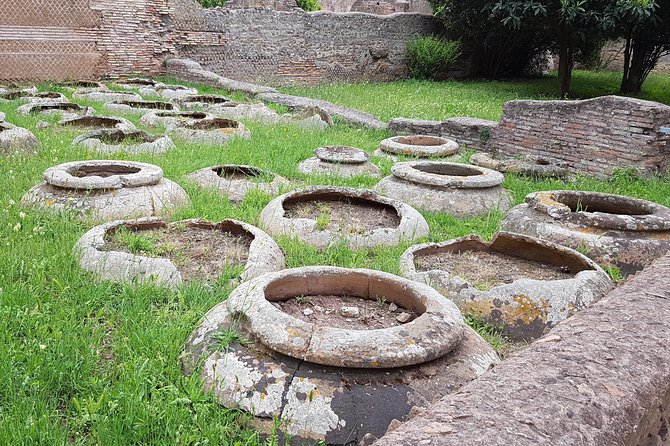
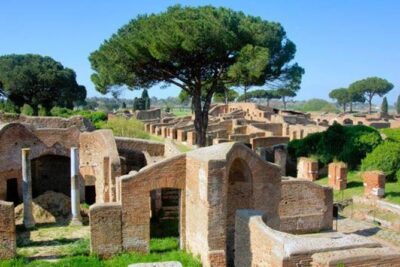
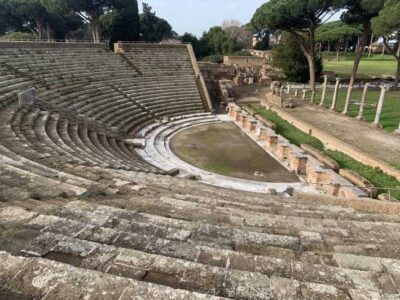
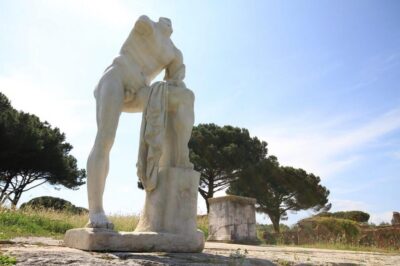
Among the features you may see are bathhouses with mosaics, a theatre, market stalls, temples, homes, and heating systems. Ancient public toilets are part of the picture, too. These details turn the visit from a tour of impressive ruins into a look at the practical arrangements of city life.
Ostia is often compared with Pompeii, and it offers a useful alternative if Pompeii is too far away for your Rome itinerary. It is close enough for a half-day excursion, yet gives you the chance to spend real time among the ruins. The scale and setting are different, so don’t expect a copy of Pompeii. Think of it as a substantial ancient city visit with its own character.
Meet at Piramide and let the train do the work
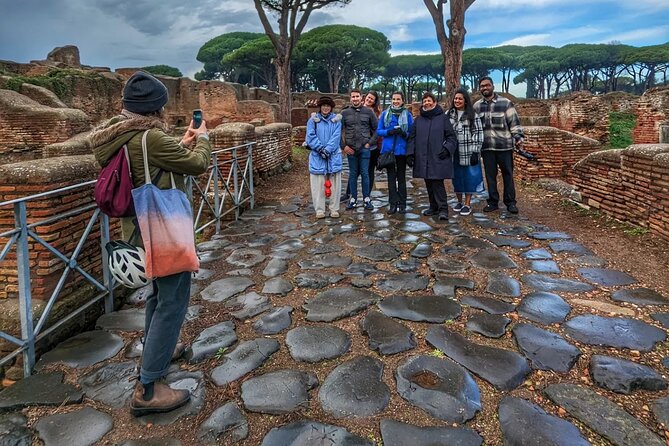
The tour begins at 8:30 am at Piazza Ostiense, near Piramide Metro Station. You meet your guide there and travel together by train to Ostia Antica. Train tickets are not included, but the guide helps you purchase them at the meeting point. The stated cost is €3 per person for a round trip.
Taking the train is a practical choice. It bypasses local traffic and makes the journey straightforward, especially if you are new to Rome’s transport system. One account describes the ride as roughly 25 minutes, though you should allow for the full meeting and travel process rather than treating that as a guaranteed door-to-door time.
The outing lasts about four and a half hours, with roughly four hours at the archaeological site. That leaves room for the train journey, explanations, and a break without turning the excursion into a full-day commitment. You can return to Rome with the guide or, according to the tour plan, remain at the site to explore on your own. The activity details also give the meeting point as the end point, so confirm the return arrangement with your guide before you decide to stay longer.
More private tours in Rome:
- Rome by Golf Cart Private Tour: Beyond the Landmarks
★ 5.0 · 4,361 reviews - Early Morning Vatican, Sistine, St. Peter’s Semi or Private Tour
★ 5.0 · 3,779 reviews - Rome on a Golf Cart Semi-Private Tour Max 6 with Private Option
★ 5.0 · 2,502 reviews
A small group gives the ruins a human scale
The group is limited to 12 people. That matters at a site where the guide’s interpretation is a large part of the experience. You can ask why a building was designed a certain way or how a feature fits into the wider city, rather than trying to catch a guide’s words from the back of a large crowd.
The small-group format also makes it easier for the guide to adjust the conversation. In one group of eight, the guide was able to take a request for an additional stop into account. That kind of flexibility is useful when a group has a particular interest, though the exact route may vary.
The guides named for this experience include Rebecca, Sonia, Camille, Ali, Fabio, and Joan. The important point is not that you can count on a particular person, but that the tour has drawn guides with relevant interests and training. Sonia has been described as studying Ostia Antica, Camille as a marine archaeologist and architecture specialist, and Ali as an archaeologist. Rebecca has been praised for explaining the archaeology and history in an engaging way.
A good guide does more here than recite dates. The city is large, and not every feature is clearly marked. Without context, you might walk past a building and struggle to understand its purpose. With a guide, the layout, mosaics, baths, and public spaces become easier to connect.
Walk the streets, baths, and public spaces
Once you enter the archaeological park, expect to spend most of the visit on foot. The tour focuses on the site’s highlights, with the guide explaining how the remains fit together and what they tell you about Roman life. The exact route is not specified, so you should not expect a fixed checklist of every building.
The variety is what gives the visit its appeal. You may move from baths and mosaics to shops, bakeries, market spaces, homes, temples, and public facilities. The theatre is another notable feature. These are not isolated curiosities: together, they show how a city’s social, commercial, and domestic life occupied the same streets.
The guide’s visual material can help with that mental reconstruction. Rebecca, for example, has used graphics to make the site easier to understand. If you have ever looked at a wall or a floor plan and wondered what was missing, a visual aid can bridge the gap between the remains in front of you and the city as it once functioned.
Ostia’s scale is also a reason to take the guided tour rather than rely only on a self-guided walk. The site is large enough that you could spend time trying to locate particular features or get turned around. One visitor who went looking for the synagogue after the tour found the route confusing. If there is a specific building you want to see, ask your guide about it before the guided portion ends.
Take the planned break, and pack for the rest
There is a restroom break midway through the visit, with time to rest and have a snack. Food and drinks are not provided, so bring what you need. This is a sensible detail for a four-hour walk, especially if you prefer not to depend on finding refreshments at the right moment.
Wear comfortable clothes and shoes. The tour takes place across an archaeological site, and the amount of walking makes footwear more important than looking dressed for a city café. Large backpacks and suitcases are not allowed inside, so leave bulky luggage elsewhere.
The experience is offered in English and uses a mobile ticket. It is near public transportation, and most people can participate. However, the tour is not described as adapted for visitors with mobility disabilities. The ground and walking demands may be challenging, so anyone with mobility concerns should think carefully before booking and contact the provider to ask about current conditions.
More Ostia Antica visits in Rome:
- Ancient Ostia Antica Semi-Private Day Trip from Rome by Train with Guide
★ 4.5 · 579 reviews - From Rome: Ostia Antica Guided Half-Day Trip by Train
★ 4.8 · 486 reviews - Horse Sanctuary & Trail Ride in Ostia Antica
★ 4.5 · 276 reviews - Ostia Antica Small Group Tour
★ 4.8 · 49 reviews
What $95.58 buys, and what it doesn’t
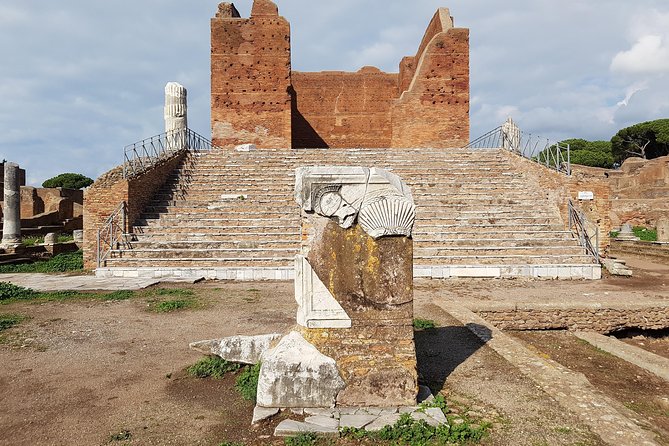
At $95.58 per person, the tour is more than a site admission ticket. The price includes Ostia Antica entry and skip-the-line admission, plus a guide for a small group. You are also paying for help with the train logistics and the interpretation that makes a wide archaeological site easier to understand.
The train fare is extra, at a stated €3 per person for the round trip. Food and drinks are not included, and there is no private transport. Keep those costs and practical needs in mind when comparing the tour with visiting independently.
The value is strongest if you want historical context and a clear route through the site. Ostia’s remains are extensive, and several buildings or features may be hard to interpret without explanation. If you are already comfortable navigating archaeological parks and prefer to explore entirely at your own pace, the guide may be less essential to you. But if your Rome plans include ancient history, the added context can make this half-day feel well spent.
The tour has a 4.8 rating from 238 reviews, and 96 percent of participants recommend it. The most consistently praised qualities are the guides’ subject knowledge, the small-group feel, and the chance to see a large, well-preserved Roman city at a manageable distance from Rome. Those are meaningful strengths, not just nice extras: they directly affect how much you understand and how calmly you can explore.
Leave time for your own Ostia plans
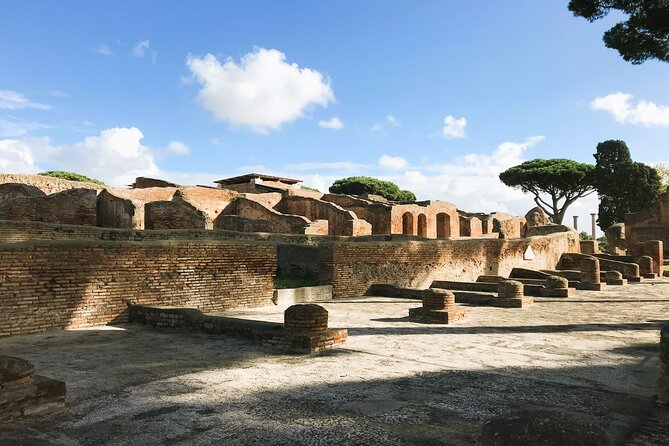
At the end of the guided portion, you can stay in the archaeological park and continue exploring on your own, or return to Rome with the guide. The tour is a useful introduction, but it does not promise to cover every corner of the site. If you have a particular interest, such as a specific building, ask about it during the visit and use any extra time to follow up.
Some visitors have paired the outing with a meal by the coast after the tour, taking the train a few stops farther. That is an optional extension, not part of the guided experience. It may suit you if you have the time and want to turn a half-day excursion into a longer day out, but you will need to arrange and pay for your own plans.
One review also describes a castle visit as an unexpected extra. Treat that as an occasional addition rather than a guaranteed stop, since the stated itinerary centers on the archaeological park.
Is this Ostia Antica tour worth booking?
I would book this tour if you are interested in ancient Rome and want to understand more than the headline monuments. Ostia Antica offers a close look at how a Roman city worked, and the small group, included entry, and guide-led train journey make the outing easier to manage.
It is especially suitable if you value history, archaeology, or architecture, or if you want a quieter change of pace from central Rome. The guides’ backgrounds and the repeated praise for clear explanations are a strong match for a site where context matters.
I would pause before booking if uneven walking is a concern, if you need a fully accessible route, or if you strongly prefer to explore without a schedule. Bring comfortable shoes, a snack, and any water you need, and remember that train fare is extra. With those points in mind, this is a worthwhile half-day for seeing an ancient city up close without traveling far from Rome.
FAQ
Where does the tour start?
The meeting point is Piazza Ostiense, 9, near Piramide Metro Station in Rome. The tour starts at 8:30 am.
How much do the train tickets cost?
Train tickets are not included. The stated price is €3 per person for the round trip, and the guide helps you buy them at the meeting point.
Are Ostia Antica admission tickets included?
Yes. The tour price includes entrance tickets to the archaeological park and skip-the-line admission.
How long does the tour last?
The experience lasts about four hours and 30 minutes. Around four hours are listed for the archaeological site visit, including a break.
How large is the group?
The tour has a maximum of 12 participants.
Can I stay at Ostia Antica after the guided tour?
The tour plan allows you to stay at the site and explore on your own or return to Rome with the guide. The activity details also list the meeting point as the end point, so confirm the return arrangement with your guide.
Newly reviewed in Rome
- Rome: Neapolitan Pizza Cooking Class in Front of the Vatican★ 4.8 · 137 reviews
- Rome: St. Paul’s Within the Walls New Year’s Concert Ticket★ 4.4 · 35 reviews
- Rome: Navona Underground & Domitian Stadium Guided Tour★ 4.6 · 36 reviews
- Rome: Navona Square and École Française Underground ticket★ 3.9 · 160 reviews
- Rome: Monuments and Belvederes Bike Tour★ 4.7 · 26 reviews
- Rome: Musical Biography of Frank Sinatra Concert★ 3.9 · 100 reviews
- Rome: Monti Neighborhood Lunch or Dinner Food Tour★ 4.9 · 8 reviews
- Rome: Mini hike to the ancient Parco degli Acquedotti★ 4.9 · 9 reviews
Ostia Antica Tours, compared.
Ancient Ostia Antica Semi-Private Day Trip from Rome by Train with Guide
Read our review →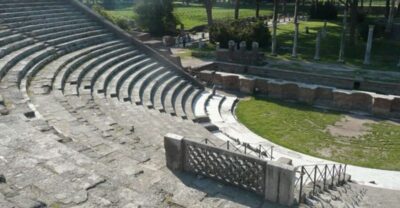

Ostia Antica: Hidden City Guided ENGLISH Tour with Transfer
Read our review →Browse the lists this tour appears in