Review · ROME TOURS
Ancient Rome: Archeological area Largo Argentina
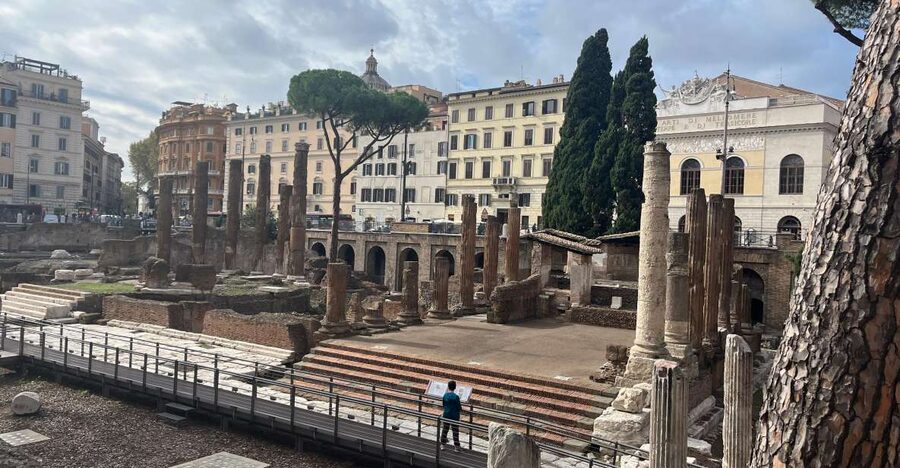
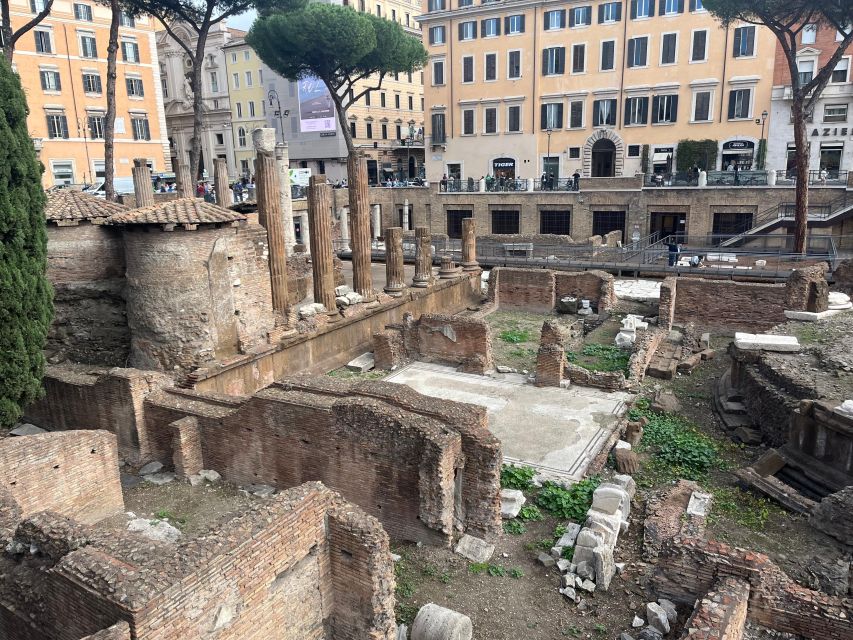
Caesar was killed in a meeting hall near this patch of Rome, and the remains of the Curia of Pompey still point to the spot. Largo Argentina is less a grand monument than an ancient island in the middle of today’s city: four temples, layers of later building, and modern streets just beyond the excavation.
I like two things about this visit: the multimedia film helps you picture the buildings as they once looked, and the site puts several centuries of Roman architecture in one compact place. One consideration: there is no live guided tour, and much of the archaeological area can be seen from outside, so the ticket is most useful if you want the film, audio guide, and access to the excavations.
- Four temples span centuries: The ruins date from the 4th to 1st centuries BC, making this a compact introduction to early Rome.
- Caesar’s assassination has a specific setting: The tuff base of Pompey’s Curia marks the area associated with his death on the Ides of March in 44 BC.
- A film adds visual context: Allow about 25 to 30 minutes for the multimedia presentation at the Touristation office.
- The ticket office is not at the site: Redeem your voucher at Piazza d’Aracoeli 16, roughly a six-minute walk from Largo Argentina.
- This is self-guided: You get an English audio guide app, not a guide leading a group through the ruins.
- The visit is short: Plan for about an hour, including the office stop and time at the archaeological area.
A small archaeological site with a big Roman story
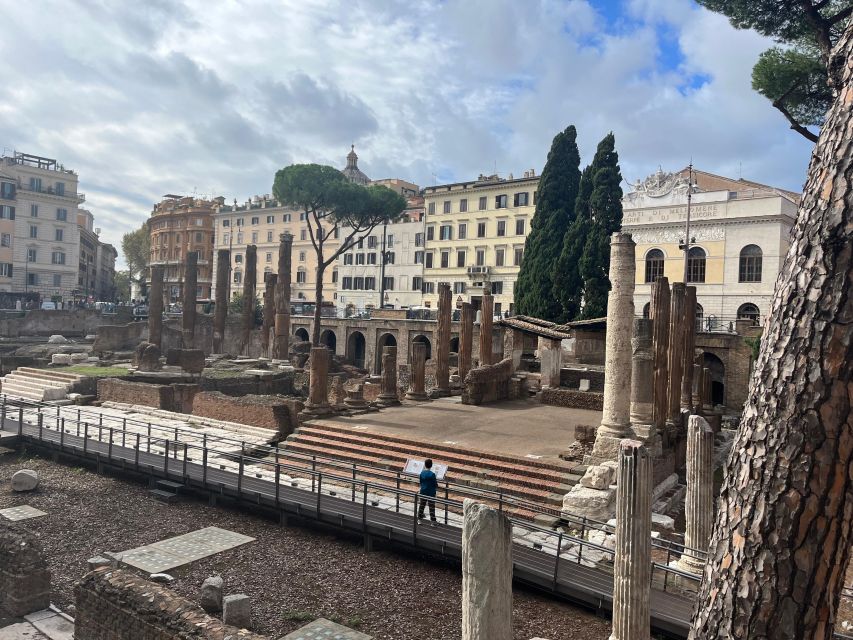
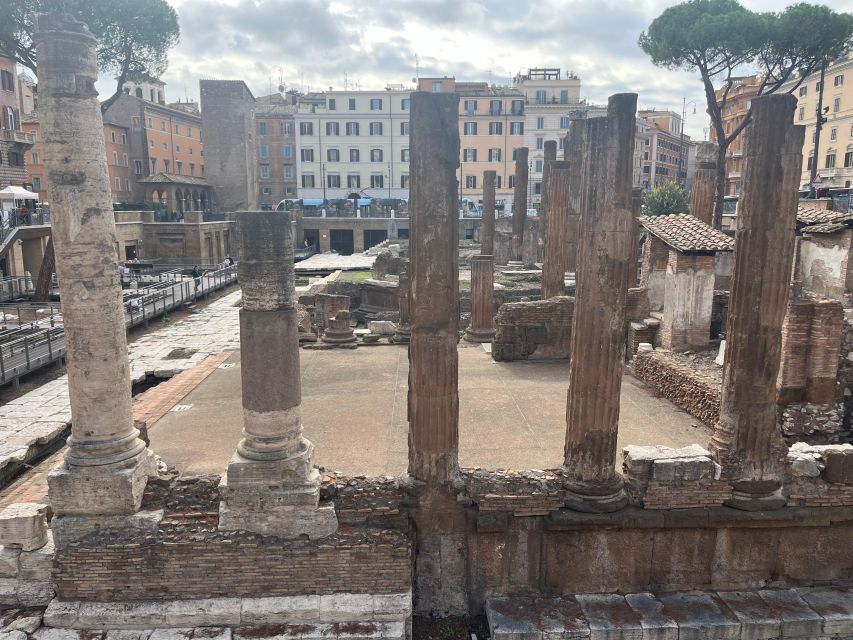
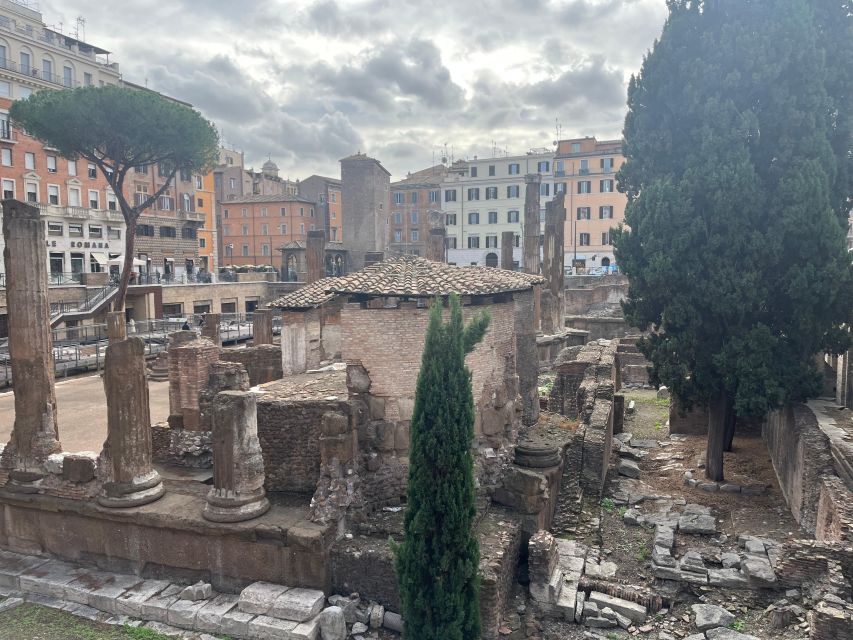
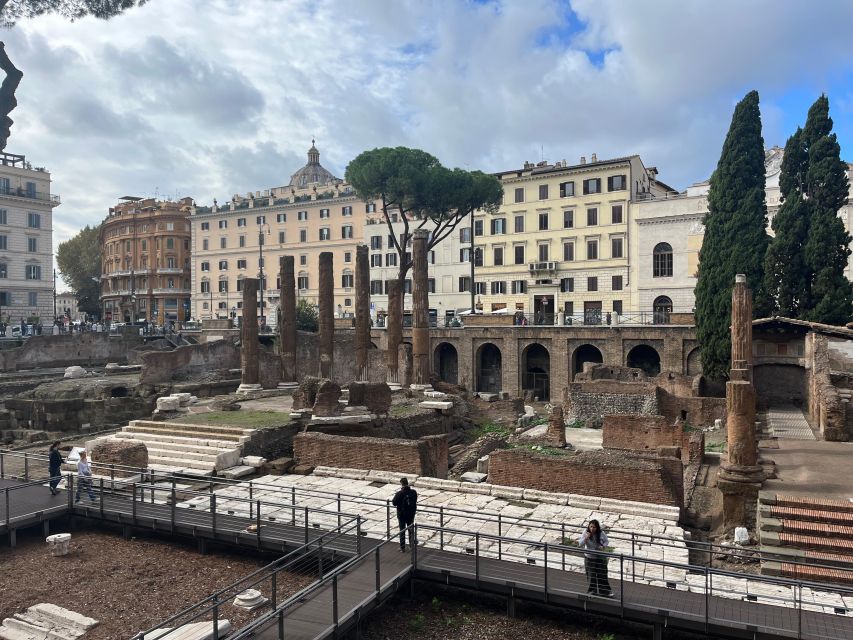
Largo di Torre Argentina sits amid the traffic and everyday movement of central Rome. Look down into the excavation and the city seems to open a window onto an older one: four temple remains, fragments of later buildings, and the ground where the Curia of Pompey once stood.
The site’s connection to Julius Caesar is its strongest draw. Ancient accounts place his assassination here on March 15, 44 BC, the Ides of March. The remains associated with the tuff base of Pompey’s Curia help locate the setting, though this is not a preserved room where you can stand and reconstruct the scene in full.
That distinction matters. You come here to see archaeological remains and understand their place in the city, not to walk through a complete temple or a restored senate hall. The experience rewards a little imagination, helped by the film and audio guide.
The area also offers a quick lesson in how Rome keeps changing while retaining traces of its past. These ruins survived later phases of use and construction, including medieval structures, rather than remaining frozen as a single ancient site. You are looking at a long sequence of occupation, not just the aftermath of one famous killing.
Four temples, from the 4th to 1st centuries BC
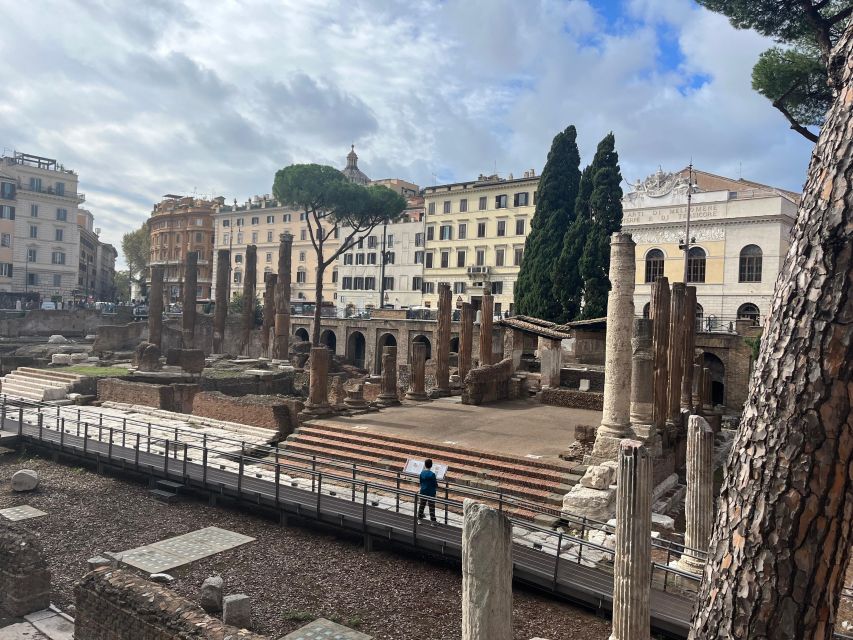
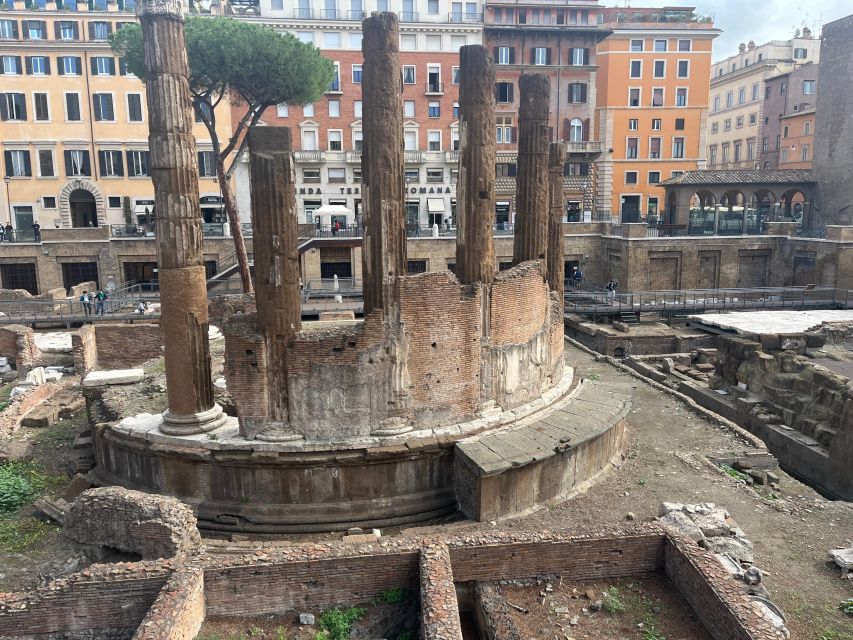
The archaeological area contains four temples built between the 4th and 1st centuries BC. Their close grouping makes it easy to compare the remains and get a feel for the site’s early religious importance, even if the fragments can be hard to read without context.
The temples are the main reason to look beyond the Caesar story. They anchor the site in a much longer stretch of Roman history, and their different periods of construction remind you that this area developed over time. The remains are not presented as a neat row of intact buildings, so the audio guide and film can help turn stones and foundations into a more legible picture.
Excavations and demolitions between 1926 and 1930 brought the ancient remains to light. That modern chapter is part of the site’s story too: the archaeological area exists in its present form because work in the twentieth century uncovered what had been buried beneath later development.
Allow yourself time to look around rather than treating the temples as a quick photo stop. The site is compact, but a few minutes spent matching the visible remains with the audio guide can make the difference between seeing four sets of stones and understanding why they matter.
More tours and experiences in Rome:
- Vatican: Museums & Sistine Chapel Entrance Ticket
★ 4.5 · 144,003 reviews - Vatican Museums & Sistine Chapel Tour with Optional Basilica
★ 4.3 · 67,413 reviews - Colosseum, Roman Forum & Palatine Guided Tour
★ 4.7 · 63,148 reviews
Finding the place linked to Caesar’s death
The most evocative point is the remains guarding the tuff base of Pompey’s Curia. This is the setting identified with Caesar’s assassination, carried out by conspirators on the Ides of March in 44 BC, according to ancient sources.
The site does not recreate the event with elaborate staging. Instead, the value lies in the link between a surviving archaeological footprint and one of the best-known turning points in Roman history. You are standing at a place connected to the end of Caesar’s life and the political upheaval that followed, even if the building itself is no longer standing in its ancient form.
I would keep expectations grounded. The remains do not reveal every detail of the attack, and you should not expect a complete interior or a dramatic memorial. The audio guide and film provide the interpretive layer; the physical site gives you the location and the scale.
That combination suits visitors who enjoy connecting a famous event to a real place. If you mainly want an intact monument, this may feel modest. If you like seeing how a historical setting survives as fragments inside a modern city, it is a worthwhile stop.
The film and audio guide do the explaining
The visit includes a multimedia video at the Touristation office, listed as 30 minutes. A visitor’s account described a presentation closer to 25 minutes, so allow roughly 25 to 30 minutes rather than building a tight schedule around an exact runtime. The film overlays images of what the buildings may have looked like in antiquity, giving the ruins a useful visual frame.
That is probably the most helpful part for anyone who finds archaeological sites difficult to interpret. A temple base can be hard to imagine as a complete building; a visual reconstruction gives you a starting point before you look at the remains in person.
You also receive an English audio guide app for Rome. There is no live guide included, so you set your own pace and follow the explanations on your phone. The package also includes WiFi, a paper city map, and assistance at the meeting point.
The separate film and audio guide have different roles. The film helps you picture the ancient structures, while the app is intended to accompany your visit. If you prefer a guide who can answer questions and adjust explanations as you go, this format will not replace that experience.
The office stop and the walk to the site
Your booked time refers to the Touristation Aracoeli office at Piazza d’Aracoeli 16, not to your arrival at the archaeological entrance. Look for the fountain and orange flags in front of the office. From there, the site is about a six-minute walk away.
This extra stop is easy to overlook when planning. You need time to redeem the voucher, watch the film, and then walk to Largo Argentina. For a one-hour activity, that sequence takes up a meaningful share of the visit, so do not assume you will spend the full hour inside the excavation.
The ticket includes reserved entrance and is described as skip-the-line access. Still, the value of that feature may depend on conditions on the day. One visitor found it just as easy to buy a ticket at the site, and another noted that much of the area can be seen from outside. If you are weighing the ticket mainly as a way to avoid a queue, consider that the film and included materials may be the stronger reasons to book.
Bring your passport, as it is listed among the required items. Pets, glass objects, luggage or large bags, and alcohol or drugs are not allowed. Food, drink, and transport are not included.
Same city, a different way to spend the day:
- Vatican Museums, Sistine Chapel & St Peter’s Basilica Guided Tour
★ 4.5 · 39,149 reviews - Rome: Colosseum, Palatine Hill and Roman Forum Guided Tour
★ 4.8 · 32,814 reviews - Rome: Guided Tour of Colosseum, Roman Forum & Palatine Hill
★ 4.7 · 27,897 reviews - Rome: Colosseum & Forum with Audio Guide App -Optional Arena
★ 4.2 · 24,770 reviews
Is $23 a fair price for an hour?
At $23 per person, this is a modestly priced, short history stop rather than a full guided excursion. The value depends on how much you want the included interpretation. If you plan to watch the film, use the audio guide, and enter the excavations, the package offers more than a quick look at the ruins from the street.
If you only want to see the temples from outside, the price is harder to justify. The archaeological area is compact, and a portion of it can be viewed without entering. The small underground museum is also a limited part of the visit, not a large museum experience that would occupy an afternoon.
I would think of the ticket as paying for context as much as access. The film’s visual reconstruction can make the ruins easier to understand, and reserved entry gives you a defined visit. But the one-hour duration includes the Touristation stop, so the on-site portion is brief.
The flexible booking terms improve the practical value: you can reserve now and pay later, and cancel up to 24 hours in advance for a full refund. Those terms are useful if your Rome plans are still shifting, but they do not change the basic question: do you want the film and audio interpretation, or would a view from outside be enough?
Who will enjoy this stop most?
This visit suits first-time visitors who want a compact introduction to ancient Rome beyond the city’s largest monuments. It also works well if Caesar’s assassination interests you and you want to connect the story with a specific archaeological setting.
It is a good fit for people who like independent sightseeing. You can use the app and move at your own pace, without following a group. The paper map and meeting-point assistance are practical extras, especially if this is one stop in a day of walking around central Rome.
History-minded visitors may appreciate the mix of ancient and later remains. The temples date across several centuries, while the site also preserves traces of imperial phases and medieval structures. That layered story gives the area more depth than the assassination connection alone.
You may want to skip it if you expect a long, guided tour or a dramatic, fully reconstructed monument. The experience is brief, the ruins are fragmentary, and the ticket office is a separate stop. Those are not flaws if you know what you are buying, but they shape the visit.
Should you book the Largo Argentina visit?
Book it if you want a short, self-guided look at four early temples and the place linked to Caesar’s death, with a film that helps you picture the ancient buildings. The English audio guide, reserved entrance, and city map add convenience, and the flexible cancellation terms make it easier to fit into a changing itinerary.
Think twice if you only want a quick exterior view or need a live guide to bring the ruins to life. The site can be seen in part from outside, and the office stop takes time. For an hour and $23, the best reason to go is not simply to stand near old stones, but to connect those remains with Rome’s long history and one of its most consequential events.
FAQ
How long does the activity take?
The stated duration is one hour. The booked time is for the Touristation Aracoeli office, where you redeem your voucher and watch the multimedia video before walking to the site.
Where do I meet?
Redeem your voucher at Touristation Aracoeli, Piazza d’Aracoeli 16. A fountain and orange flags are in front of the office entrance.
Is the meeting point at Largo Argentina?
No. The Touristation office is about a six-minute walk from the archaeological area.
Is a live guided tour included?
No. A guided tour is not included. The package provides an English audio guide app instead.
What language is the audio guide?
The audio guide is in English.
What does the ticket include?
It includes reserved entrance to the Largo Argentina excavations, a 30-minute multimedia video, the Rome audio guide app, assistance at the meeting point, a paper city map, and WiFi.
Do I need to bring identification?
A passport is listed among the things to bring.
Can I bring a large bag or luggage?
No. Luggage and large bags are not allowed.
Are pets allowed?
No. Pets are not allowed.
Can I cancel or pay later?
Yes. You can reserve now and pay later, and you can cancel up to 24 hours in advance for a full refund.
Newly reviewed in Rome
- Rome: Neapolitan Pizza Cooking Class in Front of the Vatican★ 4.8 · 137 reviews
- Rome: St. Paul’s Within the Walls New Year’s Concert Ticket★ 4.4 · 35 reviews
- Rome: Navona Underground & Domitian Stadium Guided Tour★ 4.6 · 36 reviews
- Rome: Navona Square and École Française Underground ticket★ 3.9 · 160 reviews
- Rome: Monuments and Belvederes Bike Tour★ 4.7 · 26 reviews
- Rome: Musical Biography of Frank Sinatra Concert★ 3.9 · 100 reviews
- Rome: Monti Neighborhood Lunch or Dinner Food Tour★ 4.9 · 8 reviews
- Rome: Mini hike to the ancient Parco degli Acquedotti★ 4.9 · 9 reviews
Rome Tours, compared.
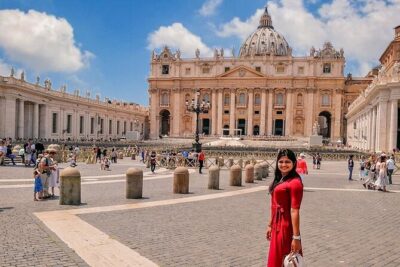
Vatican: Museums & Sistine Chapel Entrance Ticket
Read our review →
Vatican Museums & Sistine Chapel Tour with Optional Basilica
Read our review →
Colosseum, Roman Forum & Palatine Guided Tour
Read our review →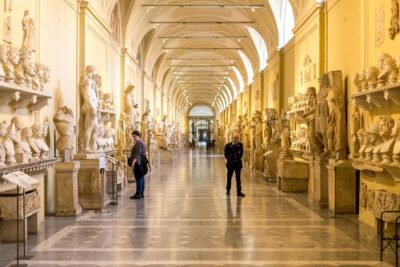
Vatican Museums, Sistine Chapel & St Peter’s Basilica Guided Tour
Read our review →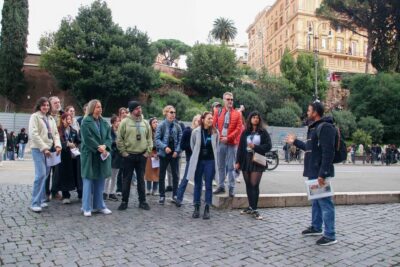
Colosseum & Forum with Audio Guide App -Optional Arena
Read our review →
Pantheon Fast-Track Ticket and Official Audio Guide
Read our review →
City Sightseeing Hop-on Hop-off Bus with Audioguide
Read our review →