
Review · TRASTEVERE TOURS
Jewish Rome District, Old Ghetto and Trastevere Private Tour
Rome’s Jewish story begins long before the city’s famous emperors. This walk follows a community whose roots reach back to the 2nd century B.C., then traces the forced Ghetto, the Great Synagogue and the river crossing into Trastevere. It’s a compact route with a lot of history underfoot.
I like that you get a private guide for a walk that links two distinct neighborhoods, and I like the route’s concrete landmarks: the Portico d’Ottavia, the Great Synagogue and the ancient Fabricio Bridge. The clearest praise available is for the guide, though no guide’s name is provided.
One consideration: three hours means moving at a steady pace, and the tour’s end point is described in two different ways. One section names Piazza Trilussa, while the meeting information says the activity ends back at the starting point. Confirm where you’ll finish before you set off.
Key points to know before you go
- Rome’s Jewish community dates to the 2nd century B.C., making this a history walk as much as a neighborhood tour.
- The old Ghetto was created in 1555 and remained in place until 1870, when Rome became Italy’s capital and Jewish residents gained citizenship.
- The route crosses the Fabricio Bridge, built in 62 B.C. and described as the oldest bridge left in Rome.
- A private guide leads the three-hour walk, with tours offered in English, Spanish, French, German, Italian, Portuguese and Russian.
- The walk ends in Trastevere or at the start, depending on which tour details you follow, so check the exact finish point ahead of time.
- The tour costs $456.21 for a group of up to one, as stated. Check the price for your actual party size before booking.
From the old Ghetto to Trastevere
This tour’s strength is its clear geographic story. You begin near the foot of Capitoline Hill, in the area where Rome’s Jewish Ghetto was established, then follow streets and monuments that explain how the community’s place in the city changed. Crossing the Tiber, you reach Trastevere, a neighborhood shaped by merchants, sailors, fishermen and people from elsewhere.
A private guide can make that sequence easier to follow than a self-guided stroll. You have one person to connect the dates and buildings, and you can ask questions as you go. The tour is listed as three hours, with about 30 minutes assigned to the Ghetto and 20 minutes each at several named stops. That calls for a focused walk rather than a long visit inside every site.
The tour is led by a guide from the Crazy4rome team. English is one of the available languages, along with Spanish, French, German, Italian, Portuguese and Russian. No individual guide is named, so you cannot request a particular person based on the details provided. The strongest specific praise is for the guide, which is encouraging, but the small amount of written feedback makes that a modest signal rather than a guarantee.
More Trastevere tours in Rome:
- Winner 2025 Rome Twilight Trastevere Food Tour by Eating Europe
★ 5.0 · 5,157 reviews - Rome: Trastevere or Jewish Quarter Street Food Tour
★ 4.8 · 3,839 reviews - Rome: Trastevere Food tour with Free-Flowing Fine Wine
★ 5.0 · 2,853 reviews
The Ghetto and its long timeline
The Jewish community in Rome dates to the 2nd century B.C. That early start gives the neighborhood a significance beyond the buildings you see today: the story is not simply about one enclosed district, but about a community present in Rome for centuries.
The Ghetto was created in 1555, at the foot of Capitoline Hill, and Jewish people were forced to live there until 1870. After Rome became the capital of Italy, the old Ghetto was dismantled and Jewish residents were granted citizenship. A guide can help you hold those events together as you walk streets that now feel like part of the wider city.
The tour gives about 30 minutes to the Jewish Ghetto, followed by stops at Piazza Mattei, Portico d’Ottavia and Via della Reginella. The value is in seeing the area as a connected neighborhood rather than a string of isolated sights. You can pay attention to how the route moves from the broad historical account to specific streets and landmarks.
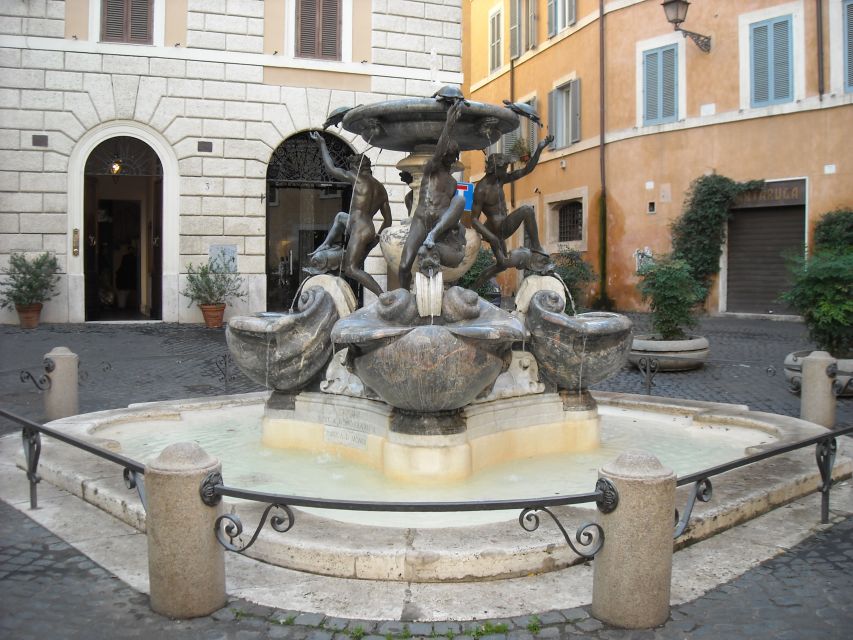
Piazza Mattei gets about 20 minutes. The tour identifies it as a guided stop, but does not specify which features or stories the guide will focus on there. Treat this as a chance to orient yourself and ask questions, rather than expecting a fixed presentation on a particular detail.
Portico d’Ottavia and Via della Reginella
Portico d’Ottavia is one of the route’s central landmarks, with a 20-minute guided stop. Its place on the itinerary makes it a useful anchor for understanding the old district and its layers of history. The tour does not promise entry to a particular building, so expect an outdoor walking visit unless your guide tells you otherwise.
Via della Reginella also receives about 20 minutes. The street is part of the former Ghetto route, and walking it gives the tour a more human scale than a series of monument stops. The larger story of confinement and later change becomes easier to consider when you are moving through the district itself.
You do not need tickets for the tour, according to the activity details. There is also a note about skipping the line through a separate entrance, but no ticketed attraction or interior visit is specified. I would not book on the assumption that this includes synagogue entry or access to another paid site.
The Great Synagogue and the change in status
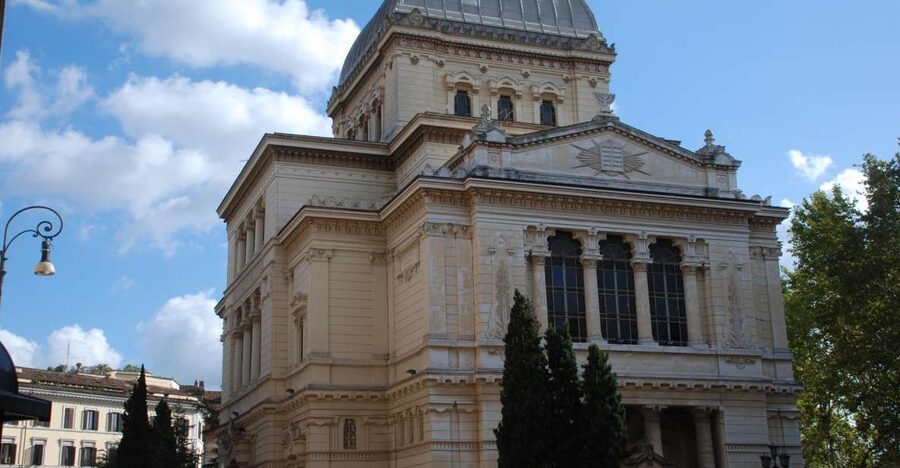
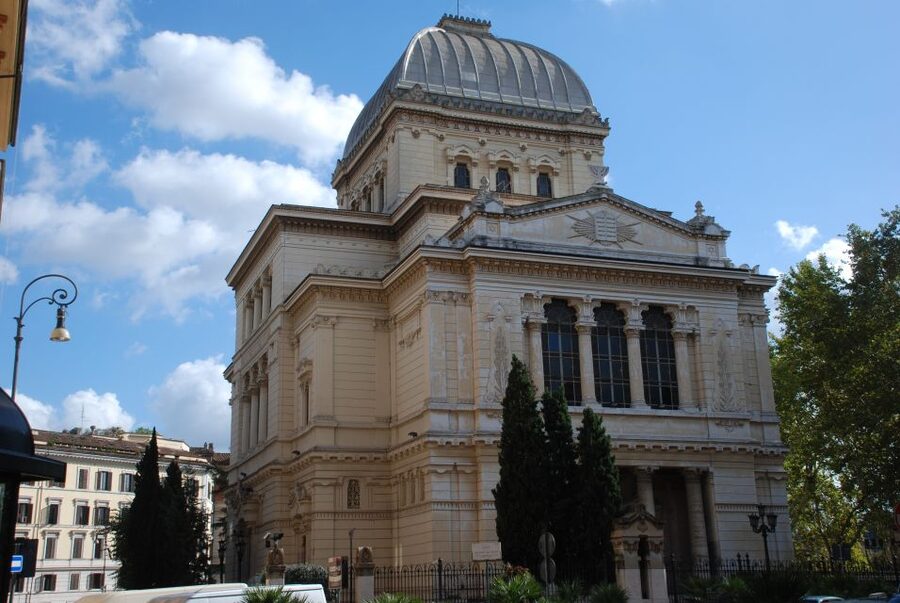
The Great Synagogue was built between 1901 and 1904, after the Ghetto had been dismantled and Jewish residents had gained citizenship. The monumental temple was created to mark that change and remains Rome’s main Jewish temple. That timing makes it more than an architectural stop: it connects the end of the Ghetto to a new public place for the community.
The route allows 20 minutes at the synagogue. That is enough for a guided explanation and a look at the site from the route, but the details do not state that the tour enters the building. If seeing the interior is important to you, ask about access before booking rather than assuming it is included.
The surrounding district remains a landmark for Rome’s Jewish community, with shops and kosher restaurants. The tour is not described as including a meal or a restaurant visit, so plan those separately. Still, knowing that the area continues to serve the community helps you read it as a living neighborhood, not only a chapter in the past.
More Jewish Ghetto tours in Rome:
- Jewish Ghetto and Trastevere Tour Rome
★ 4.5 · 1,729 reviews - Jewish Ghetto and Synagogues with Jewish Roman Guide 3 Hours
★ 5.0 · 907 reviews - Rome: Eat Like a Roman Ghetto & Campo de’ Fiori Food Tour
★ 5.0 · 743 reviews - Jewish Ghetto & Piazza Navona: Food, Wine & Sightseeing Rome Tour
★ 5.0 · 460 reviews
Fabricio Bridge, Tiber Island and the river crossing
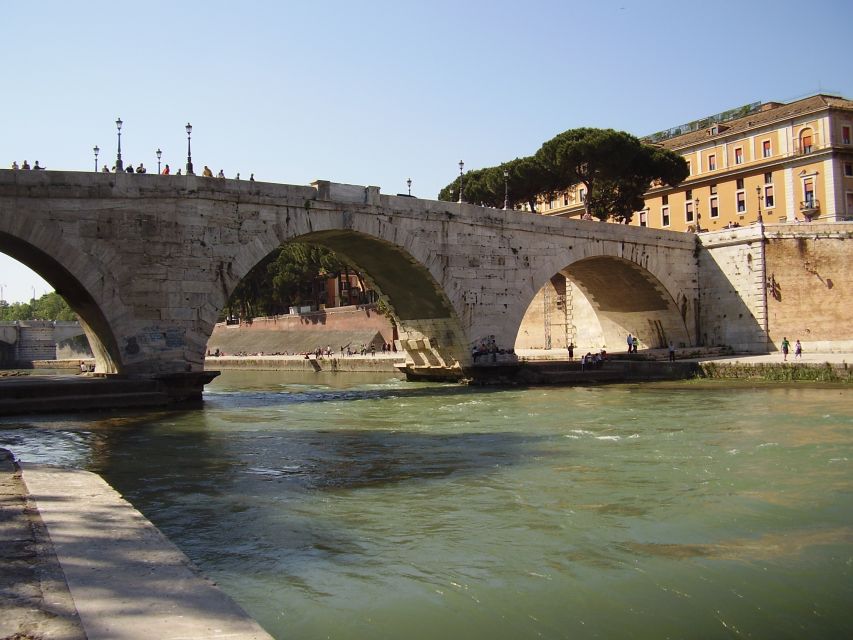
From the Jewish district, the route crosses the Fabricio Bridge to Tiber Island. Dating to 62 B.C., the bridge is described as the oldest bridge still standing in Rome. That makes the crossing one of the tour’s best chances to connect ancient infrastructure with a modern walking route.
The bridge is not just a way to get from one neighborhood to another. It marks a shift in the tour’s setting, from the Jewish district to the right bank of the Tiber. Tiber Island gets its own 20-minute guided stop, giving your guide time to explain its place in the route. Specific island sights are not named, so the experience will depend in part on the guide’s commentary.
The itinerary’s sequence is appealing because the river crossing gives the tour a natural turning point. You are not simply doubling back through the same streets. Instead, you follow Rome’s geography into another quarter with a different character and a different history.
Trastevere’s lanes and Piazza Trilussa
Trastevere developed on the right bank of the river as an area for merchants, sailors, fishermen and foreigners. The neighborhood is known here for its narrow, winding streets, cobblestones and old houses. After the more concentrated history of the Ghetto, the walk’s final stretch lets you see another side of Rome’s urban past.
The tour sets aside 20 minutes for Trastevere. That is enough to get a sense of its layout and hear some context, but not enough for a leisurely wander through every lane. If you want to linger, have a meal or explore the neighborhood at your own pace, plan extra time after the guided walk.
The route names Piazza Trilussa as its finish. However, the meeting information says the activity ends back at the starting point near Antico Caffè del Teatro di Marcello. That is a practical detail worth settling before you go, especially if you have a timed reservation or need to meet someone afterward.
Is $456.21 good value for a private walk?
The stated price is $456.21 for a private group of up to one person. That is a substantial cost for a three-hour walking tour, especially if you are booking solo. The details do not explain how the price changes for a larger party, so check the total for your group before deciding.
What you are paying for is a private official expert guide, not transport, meals, drinks or entry tickets. The value depends on how much you want a guide to connect the history across the route. If you are curious about the Ghetto’s creation and dismantling, the age of the Jewish community and the shift into Trastevere, a private guide may be more useful than a general orientation walk.
If you mainly want to see the streets and monuments without much explanation, you could walk through these areas on your own and avoid the guide fee. But the route covers a long span of history in a short time, and private guiding gives you room to ask questions. For a solo visitor, compare the stated cost with the benefit of having the guide’s full attention.
The activity is wheelchair accessible, but it is still a walking tour through historic districts. Comfortable shoes are recommended, and luggage or large bags are not allowed. No transport to or from your hotel is included.
Who should book this walk?
I’d consider this tour if you want a focused introduction to Rome’s Jewish history and prefer to explore with a guide rather than read plaques as you go. It is also a good fit if you want to connect the Ghetto, the river and Trastevere in one outing, rather than treating them as separate stops.
It may be less appealing if you want a slow visit with long time inside museums or religious buildings. The schedule gives only about 20 minutes to most stops, and entry to the Great Synagogue is not confirmed. It is also worth weighing the price carefully if you are travelling alone.
Before booking, settle two points: the price for your party and the tour’s exact finish location. The stated free-cancellation window is up to 24 hours in advance, and the reserve-now, pay-later option lets you hold a spot without paying immediately. Those terms offer flexibility, but the route and its history are the real reason to choose this walk.
FAQ
How long is the tour?
The private walking tour lasts three hours. Starting times depend on availability.
What languages can the guide speak?
Tours are offered in Spanish, English, French, German, Italian, Portuguese and Russian.
Are tickets included or required?
No tickets are required for the tour. The details do not confirm entry to the Great Synagogue or any other paid attraction.
Where does the tour start?
The meeting point is at the exit of Antico Caffè del Teatro di Marcello, at Via del Teatro di Marcello, 42.
Where does the tour end?
The route names Piazza Trilussa as the finish, while the meeting information says the activity ends back at the starting point. Confirm the exact endpoint before the tour.
What should I bring, and what is not allowed?
Bring comfortable shoes. Luggage and large bags are not allowed.
More private tours in Rome
- Rome by Golf Cart Private Tour: Beyond the Landmarks
★ 5.0 · 4,361 reviews - Early Morning Vatican, Sistine, St. Peter’s Semi or Private Tour
★ 5.0 · 3,779 reviews - Rome on a Golf Cart Semi-Private Tour Max 6 with Private Option
★ 5.0 · 2,502 reviews - Rome Highlights by Golf Cart Private Tour
★ 5.0 · 2,379 reviews
Newly reviewed in Rome
- Rome: Neapolitan Pizza Cooking Class in Front of the Vatican★ 4.8 · 137 reviews
- Rome: St. Paul’s Within the Walls New Year’s Concert Ticket★ 4.4 · 35 reviews
- Rome: Navona Underground & Domitian Stadium Guided Tour★ 4.6 · 36 reviews
- Rome: Navona Square and École Française Underground ticket★ 3.9 · 160 reviews
- Rome: Monuments and Belvederes Bike Tour★ 4.7 · 26 reviews
- Rome: Musical Biography of Frank Sinatra Concert★ 3.9 · 100 reviews
- Rome: Monti Neighborhood Lunch or Dinner Food Tour★ 4.9 · 8 reviews
- Rome: Mini hike to the ancient Parco degli Acquedotti★ 4.9 · 9 reviews
Trastevere Tours, compared.

Winner 2025 Rome Twilight Trastevere Food Tour by Eating Europe
Read our review →
Trastevere or Jewish Quarter Street Food Tour
Read our review →
Trastevere Food tour with Free-Flowing Fine Wine
Read our review →
Trastevere & Campo de Fiori Street Food Walking Tour
Read our review →
Award Winning Trastevere Group Food Tour with Wine
Read our review →

Rome Food Tour: Hidden Gems of Trastevere with Dinner & Wine
Read our review →Browse the lists this tour appears in