
Review · ROME CATACOMBS TOURS
Rome: Catacombs of St. Callixtus Entry Ticket & Guided Tour
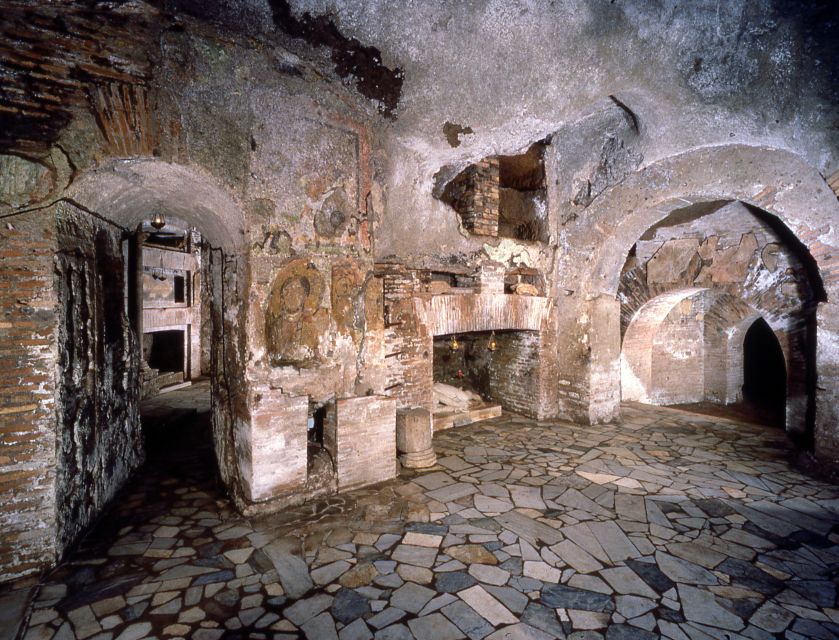
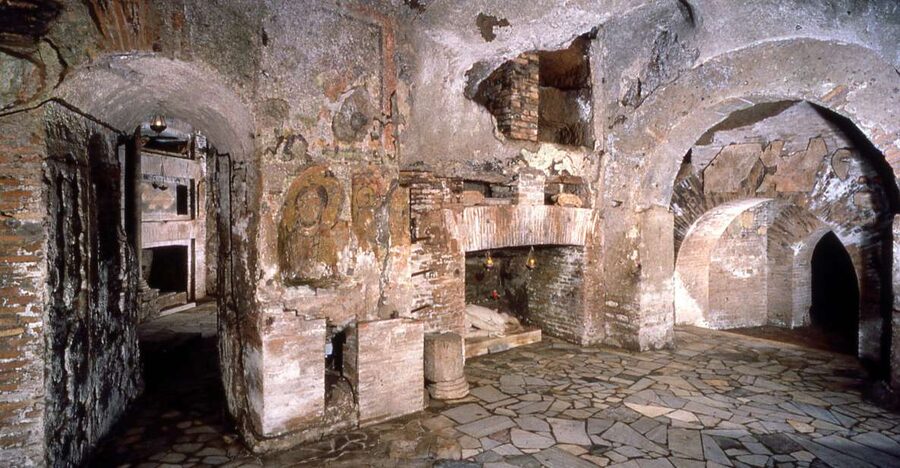
Beneath the Appian Way, the Catacombs of St. Callixtus hold the burial places of early Christians, including popes and martyrs. This half-hour visit takes you into a network of underground passages for a guided look at its burial chambers, frescoes, and the Crypt of the Popes.
I like two things in particular: the compact tour packs real historical context into 30 minutes, and its focus on Christian burial customs makes a useful counterpoint to Rome’s grand public monuments. One practical catch: the catacombs sit outside the city center, so you’ll need to plan your journey and allow time to find the ticket office.
At a glance
- The Crypt of the Popes is the resting place of nine popes and three bishops.
- The Crypt of St. Cecilia connects the underground visit with the story of a Roman matron remembered for helping martyrs receive proper burials.
- Early frescoes and the cubicles of the sacraments offer a glimpse of the art and religious life of Rome’s first Christian communities.
- The tour lasts about 30 minutes, with a guide in English, Italian, French, or German.
- The burial site is not a display of skeletons. You’ll see the chambers and burial places, and learn about the people and customs associated with them.
- Plan for an out-of-center location: local buses reach the site, but you’ll want extra time for the trip and the meeting point.
A quieter side of Rome beneath the Appian Way
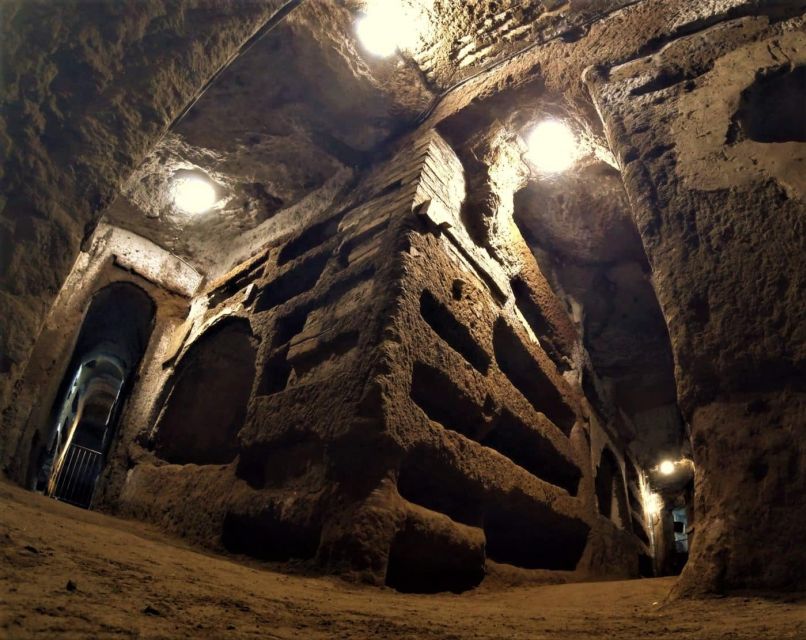
The Catacombs of St. Callixtus are among Rome’s largest underground burial grounds and were the oldest official cemetery of the city’s Christian community. The complex lies beneath the Appian Way, a historic road just beyond central Rome. Its scale gives the visit a different feel from a walk through a single tomb: you’re entering part of an extensive network associated with the burial of an estimated half a million Christians.
That number helps explain why this place matters, but the tour is not just about scale. Your guide connects the underground passages with the early Christian community, its burial traditions, and the figures remembered here. You’ll hear how the cemetery got its name and learn about the popes, bishops, martyrs, and ordinary Christians whose burial places occupy the complex.
I like this visit for the way it adds human detail to a Rome trip often dominated by emperors, marble, and monumental churches. The catacombs are a burial site, not a theatrical attraction. Expect a historical and religious setting, with a respectful tone and a guide who helps you make sense of what you’re seeing.
More catacomb tours in Rome:
- Rome: Crypts and Catacombs Underground Tour with Transfers
★ 4.6 · 5,341 reviews - The Original Roman Crypts and Catacombs Tour with Transfers
★ 4.5 · 4,896 reviews - Rome: Guided Roman Catacombs Tour with Transfers
★ 4.6 · 1,830 reviews
The route through the catacombs
The guided visit begins after you meet your guide and enter the burial complex. The route takes you through underground passages and chambers, with explanations of how the cemetery developed and how Christians used these spaces. Because the visit is guided, you should plan to stay with your group rather than wander independently.
The first useful shift in perspective is understanding that the catacombs were a cemetery, not a hiding place designed for dramatic escape scenes. The guide gives context to the burial chambers and the community that used them. That background makes the plain corridors more meaningful: the point is not ornate architecture, but the people and customs that shaped this place.
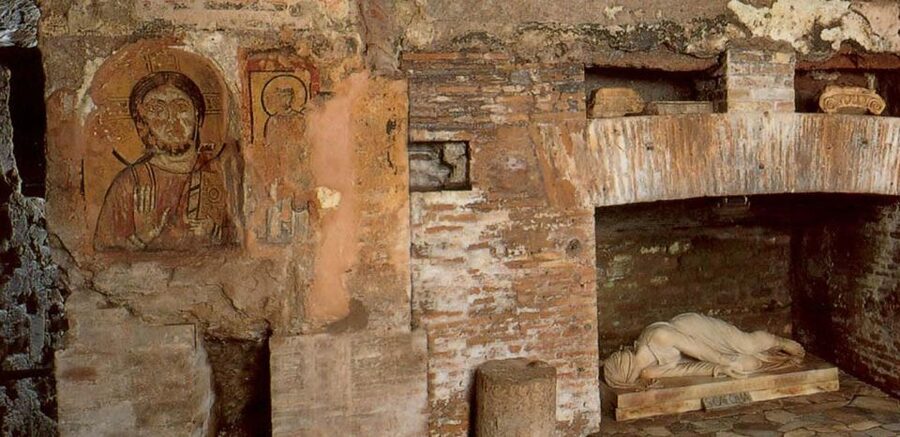
The visit includes the Crypt of the Popes, where nine popes and three bishops were laid to rest. This is one of the most historically significant stops, and the guide explains its place in early Christian history. You’ll also go to the adjoining Crypt of St. Cecilia, associated with a Roman matron remembered for ensuring that many martyrs received proper burial.
Another highlight is Area I, where the cubicles of the sacraments are located. The tour also shows some of the oldest frescoes found in Rome’s catacombs. These painted traces can be easy to pass without context, so having a guide point them out is a real advantage. They help turn a walk through ancient burial rooms into a more legible account of belief and community.
The visit is short, but it includes several distinct points of interest. Some tours may run a little longer than the scheduled half-hour, but you should still treat this as a focused introduction rather than an exhaustive exploration of the complex.
What the experience feels like underground
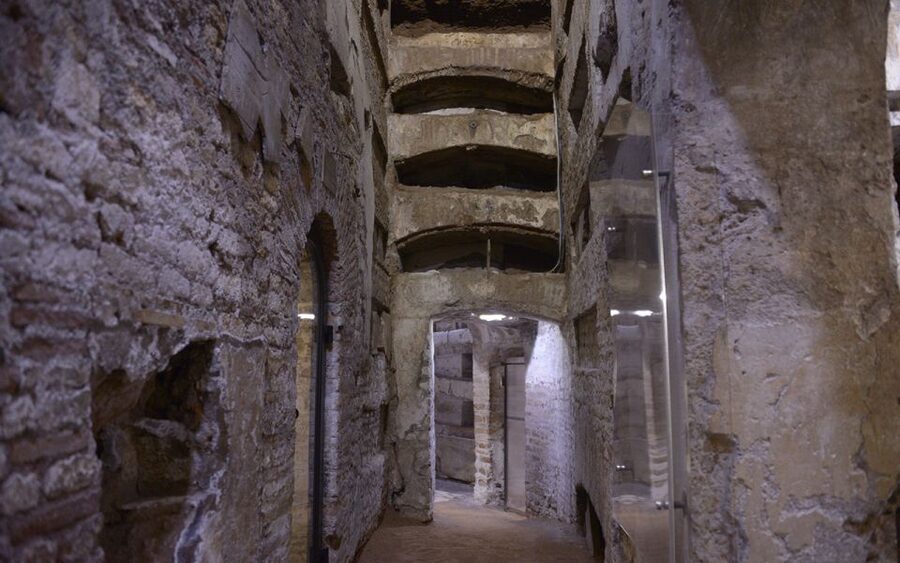
The catacombs are cool compared with Rome’s streets, a welcome change on a hot day. One visitor described the underground temperature as about 15 degrees Celsius, so a light sweater or jacket is a sensible choice even in summer. Wear comfortable shoes and clothes; you’ll be moving through an underground site, not strolling through a polished museum gallery.
The setting is quiet and solemn. That atmosphere suits the subject, though it may not be for everyone. The tour is not suitable for people with claustrophobia or mobility impairments, and baby carriages are not allowed. If you’re unsure how you’ll manage the underground environment or walking conditions, consider that before booking.
Photography is prohibited inside. I understand the restriction in a place of burial, but it can disappoint if you hoped to take pictures of the chambers or frescoes. Leave the camera in your pocket and focus on the guide’s explanations and the details you can see in person.
It’s also worth setting expectations about what you’ll see. The focus is on burial places, chambers, and history, not exposed bones or skeletons. If you’re interested in early Christian communities and ancient burial customs, that distinction should not lessen the visit. If your main reason for going is to see human remains, this is not the right experience.
The guide makes a short visit count
A good guide is especially important here. In half an hour, you have limited time to understand the site, so clear storytelling can make the difference between a string of corridors and a meaningful visit. Guides have included Sam, Francesca, and Fr Peter, among others. Your guide depends on the tour time and language, so don’t book expecting one particular person.
The strongest guides bring both facts and warmth. Some have answered questions after the formal visit or pointed out additional places on the property. Others have used humor while explaining the history, which can help keep a short tour lively without turning a solemn site into a performance. Visitors have also appreciated guides who speak clearly, wait for the group, and make space for questions.
Tours are offered in English, Italian, French, and German. Check that your chosen departure is in a language you understand well. That matters more here than it might on a sightseeing walk: much of the value lies in the explanations, since you can’t explore the catacombs freely on your own.
More tickets in Rome:
- Vatican: Museums & Sistine Chapel Entrance Ticket
★ 4.5 · 144,003 reviews - Rome: Pantheon Fast-Track Ticket and Official Audio Guide
★ 4.3 · 21,008 reviews - Rome:Hop-On Hop-Off Panoramic Open Bus Ticket 3 Circuits x 1
★ 4.0 · 15,405 reviews - Vatican Museums & Sistine Chapel Skip-the-Line Entry Ticket
★ 4.4 · 13,838 reviews
Getting to St. Callixtus and finding the meeting point
The catacombs are outside central Rome, so transport is part of the plan. From Termini Station, one route is Metro A toward Anagnina to San Giovanni, then bus 218 toward Ardeatina to the Fosse Ardeatine stop. The catacomb entrance is opposite the stop.
Another option is Metro B toward Laurentina to Colosseo or Circo Massimo, then bus 118 toward Appia or Villa dei Quintili to the Catacombe di San Callisto stop. Allow extra time for bus waits and the final approach. Local buses can make the journey straightforward, but connections and waiting time can add up.
Go directly to the catacomb ticket office and show your voucher at least 10 minutes before the scheduled tour. Some visitors have found the exact meeting point confusing, including the distinction between the ticket office and the parking area. Look for the ticket counter rather than assuming the bus stop or car park is the meeting point, and allow time to exchange your voucher for an entry ticket if needed.
Getting there by public transport is possible, but the return trip may take extra thought. A taxi or ride service can be a simpler choice for the outbound journey, especially if you’re short on time. One visitor noted that finding a taxi back can be tricky, so it’s wise not to assume you can simply hail one outside the site.
There is no hotel pickup or drop-off, and food and drinks are not included. Keep the journey, the tour, and your next stop in mind when planning the day. The listed visit lasts 30 minutes, but the full outing will take longer once you include travel and time at the entrance.
Is $16 good value for a half-hour tour?
At $16 per person, this is a fairly modest way to visit a major historic site with a guide and entry included. The short duration is the main limitation, but it also makes the catacombs a manageable addition to a day in Rome. You’re paying for access and a guided explanation of a place that would be difficult to understand as a set of corridors alone.
The value is strongest if you’re curious about early Christianity, ancient burial customs, or Rome beyond its best-known monuments. The guide gives you a framework for the Crypt of the Popes, the Crypt of St. Cecilia, and the frescoes, all within a compact visit. For a history-minded family with older children or teens, the focused length may be easier to fit into the day than a long museum visit.
The value is weaker if you expect a long, self-paced exploration or want to see bones. Photography is not allowed, and the tour follows a guided route. Think of it as a concise, guided introduction to an important underground cemetery, not an open-ended visit.
Who should book this tour?
I’d recommend it if you want to understand a less familiar part of Rome’s history and are comfortable with underground spaces. It suits couples, solo visitors, and families with older children who can follow a group and stay interested in a short history-focused visit. The site’s cooler air is a bonus in hot weather, though the temperature can feel chilly after the Roman sun.
I’d think twice if you have mobility limitations, claustrophobia, or a strong expectation of seeing human remains. The tour is also a less convenient fit if your Rome schedule is packed and you have little time for the trip out of the center. The visit itself is brief, but the transport is not part of that 30-minute duration.
Should you book?
Book this tour if you want a compact, guided look at early Christian Rome, especially the Crypt of the Popes, the Crypt of St. Cecilia, and the catacomb frescoes. At $16, it offers good value for a focused visit led by a guide who can explain what the underground chambers mean. Give yourself time to reach the ticket office, bring a light layer, and expect a respectful historical site rather than a display of skeletons. If those terms suit you, this is a worthwhile change of pace from Rome’s grander sights.
FAQ
How long is the Catacombs of St. Callixtus tour?
The guided tour is listed as 30 minutes. Allow additional time for getting to the site and checking in.
What does the ticket include?
The ticket includes entry to the Catacombs of Saint Callixtus and a guided tour.
What languages are available?
Tours are offered in Italian, French, German, and English. Check the available starting times for your preferred language.
Can I take photographs inside the catacombs?
No. Photography is not allowed inside.
Are the catacombs suitable for people with claustrophobia or mobility impairments?
The experience is not suitable for people with claustrophobia or mobility impairments. Baby carriages are also not allowed.
How do I get to the meeting point?
Take public transport to the Catacombe di San Callisto or Fosse Ardeatine stop, depending on your route. Go directly to the catacomb ticket office and show your voucher at least 10 minutes before the tour.
Newly reviewed in Rome
- Rome: Neapolitan Pizza Cooking Class in Front of the Vatican★ 4.8 · 137 reviews
- Rome: St. Paul’s Within the Walls New Year’s Concert Ticket★ 4.4 · 35 reviews
- Rome: Navona Underground & Domitian Stadium Guided Tour★ 4.6 · 36 reviews
- Rome: Navona Square and École Française Underground ticket★ 3.9 · 160 reviews
- Rome: Monuments and Belvederes Bike Tour★ 4.7 · 26 reviews
- Rome: Musical Biography of Frank Sinatra Concert★ 3.9 · 100 reviews
- Rome: Mini hike to the ancient Parco degli Acquedotti★ 4.9 · 9 reviews
- Rome: Monti Street Food Tour★ 4.5 · 14 reviews
Rome Catacombs Tours, compared.

Crypts and Catacombs Underground Tour with Transfers
Read our review →
The Original Roman Crypts and Catacombs Tour with Transfers
Read our review →

Rome EBike Tour: Appian Way, Catacombs & Roman Aqueducts
Read our review →
Catacombs and Capuchin Crypt Guided Tour with Transfer
Read our review →
St. Peter’s Basilica Priority Access Tour with Dome & Crypt
Read our review →
Appian Way, Catacombs, & Roman Aqueducts E-bike Tour
Read our review →Browse the lists this tour appears in