
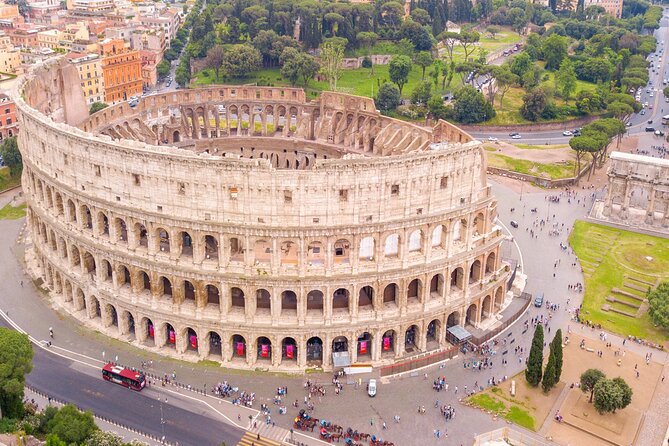
Review · COLOSSEUM TOURS
Small-group Colosseum, Forum and Palatine Guided Tour
The best part of this three-hour walk is the range: you move from the Colosseum’s arena to the Roman Forum’s temples and public buildings, then climb Palatine Hill for views over the ancient center. I like the small-group format and the way a guide can link these separate ruins into one story of Rome.
I also like that the guide explains architecture as well as history, and that the tour includes the Arch of Constantine. The main trade-off is time: three major sites in three hours can feel brisk, and security queues may leave less time inside the Colosseum than you hoped.
Key points before you book
- Three landmark sites in three hours: You visit the Colosseum, Roman Forum, and Palatine Hill, with a stop at the Arch of Constantine.
- A stated group limit of 10: The small format should make it easier to hear the guide and ask questions, though one past participant described a group closer to 20. Confirm group arrangements if size is essential to you.
- An English-speaking local guide: Expect explanations of the sites’ history and architecture, not simply a walk past the ruins.
- A brisk pace is part of the deal: The route covers a lot, and waiting at security can shorten the time available at individual stops.
- Optional hotel pick-up: Coverage depends on your hotel. If it is not covered, you need to make your own way to the meeting point.
- Bring ID and comfortable shoes: A passport is required on the day, and large bags are not allowed.
The route links Rome’s ancient center
This tour brings together three sites that are close on a map but distinct in character. The Colosseum is the dramatic opener, the Forum gives you the remains of Rome’s political and social center, and Palatine Hill adds the city’s origin stories and an elevated view across the ruins.
A guide helps turn fragments of walls and columns into a place you can picture in use. That matters here: without context, the Forum can look like a scatter of stones, while a clear explanation of temples, basilicas, and government buildings gives you a way to read what remains.
You’ll also pass the Arch of Constantine. It is listed as a visit stop, though the exact amount of time spent there is not specified. Think of it as part of the route rather than a separate, lengthy visit.
More Colosseum tours in Rome:
- Colosseum, Roman Forum & Palatine Guided Tour
★ 4.7 · 63,148 reviews - Rome: Colosseum, Palatine Hill and Roman Forum Guided Tour
★ 4.8 · 32,814 reviews - Rome: Guided Tour of Colosseum, Roman Forum & Palatine Hill
★ 4.7 · 27,897 reviews
Meeting in Colle Oppio Park
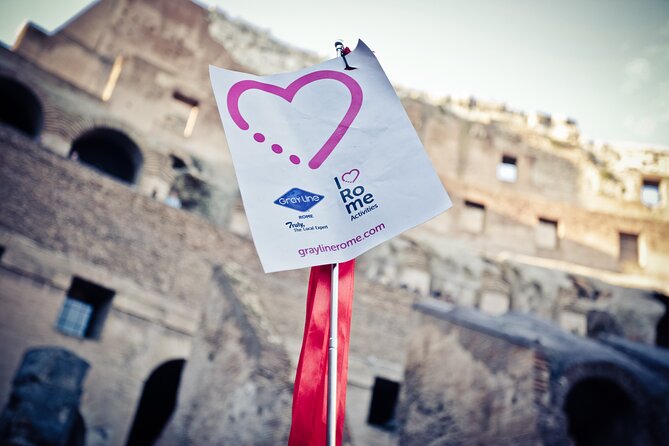
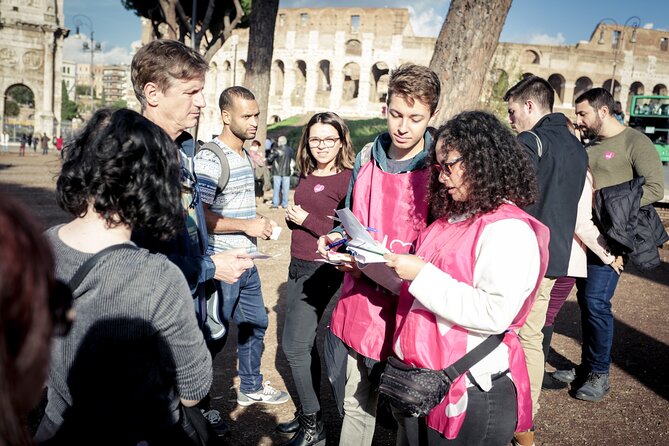
For the standard meeting option, go to Colle Oppio Park, at Via delle Terme di Tito and the corner of Via Nicola Salvi. Look for staff carrying the I Love Rome logo, and arrive 15 minutes before departure. The meeting point coordinates are 41.89193344116211, 12.49609375.
The starting location depends on the option you choose, so check your booking details rather than assuming every version begins in the park. If you book hotel pick-up, be ready in the lobby 45 minutes before departure, or 60 minutes if your hotel is outside the central area. Coverage needs to be checked with the hotel reception or booking office.
Give yourself a little breathing room on the day. Security checks can cause delays, and getting to the meeting point late could put you behind the group. You must stay with your assigned guide throughout the visit, and you cannot add an outside guide later.
At the Arch of Constantine
The Arch of Constantine is the first named stop on the route. It offers an early chance to get oriented before entering the Colosseum area, and the guide can set the scene for the monuments you’ll encounter next.
The information provided does not specify how long the group stays here or whether the guide gives a detailed account of the arch. If you are especially interested in this monument, ask your guide what to look for when you arrive. Keep expectations measured: the main focus of the tour is the Colosseum, Forum, and Palatine Hill.
Inside the Colosseum
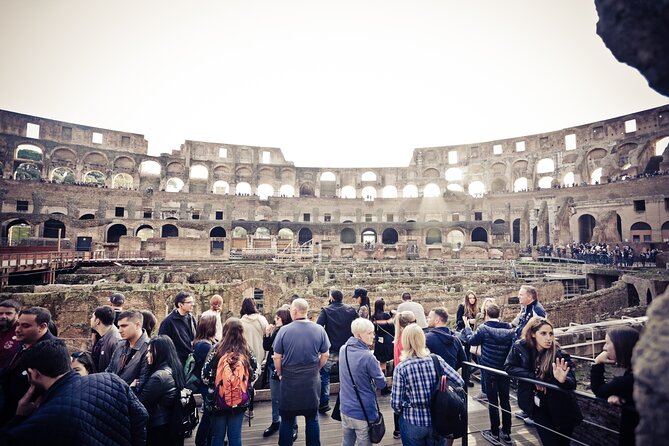
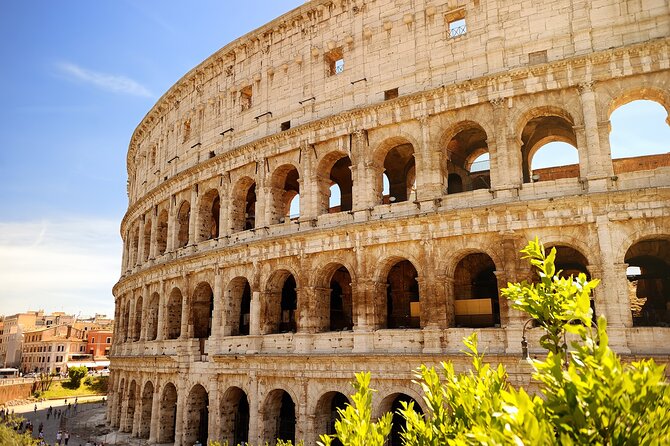
The Colosseum is the stop most people picture when they think of ancient Rome. Your guide brings attention to its architecture and historical role, and helps you imagine the gladiatorial contests once held inside. That expert framing is useful in a building whose scale can be easy to admire without understanding how it worked.
The guide’s explanations are one of the strongest reasons to choose a guided visit over exploring alone. Past participants have praised guides for giving detailed accounts, making the experience friendly, and allowing time for photographs. That combination suits you if you want both context and a few unhurried moments to take in the setting.
Still, do not assume you’ll have unlimited time to explore every part of the Colosseum. Entry procedures and security waits can slow the group, even when you have a booked tour. One participant described a long wait before the group entered and felt the Colosseum portion moved too quickly, with exhibits left unseen. That is a useful reminder: the three-hour schedule is shared across three major sites, and delays can shift the balance.
If your main priority is studying the Colosseum in depth, this may feel like a sampler rather than a specialist visit. If you want a guide to explain the building before you continue through the wider ancient center, the format makes more sense. Be ready to keep moving and use the guide’s time well by asking your questions as they arise.
More Roman Forum and Palatine tours in Rome:
- Rome: Colosseum & Forum with Audio Guide App -Optional Arena
★ 4.2 · 24,770 reviews - Rome: Colosseum, Roman Forum and Palatine Hill Guided Tour
★ 4.5 · 23,903 reviews - Rome: Colosseum, Forum & Palatine Hill Tour & Optional Arena
★ 4.4 · 13,839 reviews - Rome: Colosseum, Roman Forum, Palatine with Multimedia Video
★ 4.0 · 12,766 reviews
The Roman Forum: ruins with a story
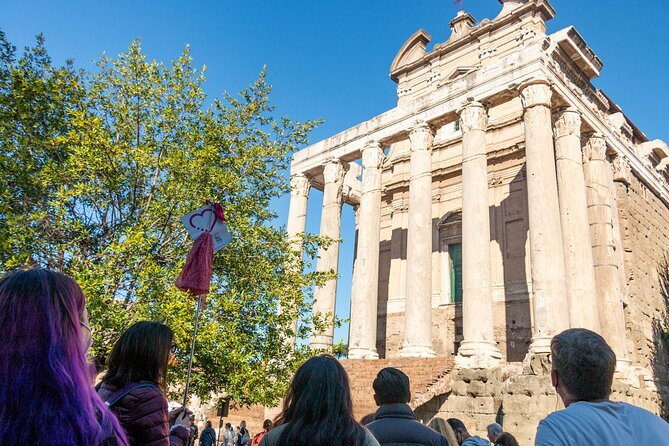
The Forum was the center of ancient Rome’s political and social life. Its remains include temples, basilicas, and government buildings, and a guide can help you understand how these structures fit together rather than leaving you to guess from their foundations.
This is where the quality of the explanation can make a large difference. A detailed guide can point out what you are seeing and give you a sense of how the area functioned. Several past participants valued the amount of information and detail, which is a good match for anyone who enjoys history more when it is tied to a specific place.
The Forum can also be the part that feels rushed. One participant felt the group barely passed through it, while another found the information at the Forum and Palatine Hill especially useful. Both reactions make sense: a three-hour tour has to divide time among all three headline sites, and people differ in how long they want to linger.
If you already know that the Forum is your main interest, consider whether this broad route gives you enough time. If you want an informed overview of the Forum as part of a larger ancient Rome visit, it offers a practical introduction.
Palatine Hill and the views
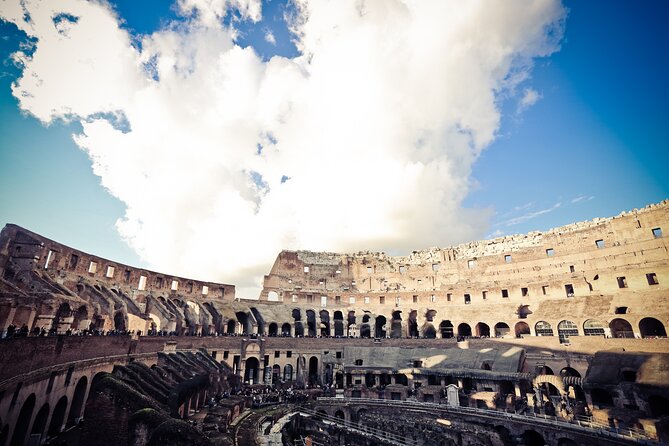
Palatine Hill takes the story from public Rome toward the city’s mythical beginnings and imperial past. The tour covers the hill’s place in Rome’s origin stories and the opulence associated with its emperors, then gives you a chance to look across the city from above.
The change in perspective is welcome after the enclosed spaces and broken walls of the other stops. The views include the Forum Boarium and the River Tiber, adding a wider sense of Rome beyond the archaeological area. Bring your camera, but keep in mind that the route is guided and the time for photographs depends on the group’s pace.
Palatine Hill is also the final named site, so it gives the tour a natural finish: first the arena, then the civic center, then the hill linked with Rome’s beginnings and imperial life. If you have moderate fitness and are comfortable walking on uneven archaeological ground, this order should feel manageable. The tour is not suitable for wheelchair users or people with mobility impairments, and it may be challenging if you have difficulty walking.
What the small group means in practice
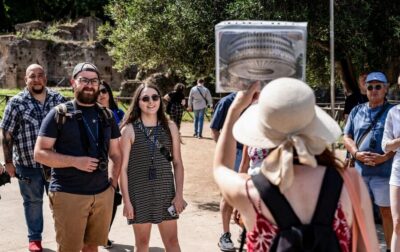
A group capped at 10 can make a guided visit feel more personal. You are more likely to hear the guide clearly, follow explanations, and ask a question without needing to call across a crowd. That matters in busy archaeological sites, where attention can be pulled in several directions.
There is one caveat worth weighing. Although the stated limit is 10, one past participant reported a group they estimated at around 20. That is not enough to conclude that larger groups are typical, but if an intimate group is the main reason you are booking, confirm the group size and language arrangement before paying.
The tour is listed in English. A past participant had booked a Portuguese-language version and reported a larger group, so check that the option you select matches your language needs. Do not assume that all departure options share the same arrangements.
Is three hours good value?
No price is provided here, so I can’t judge the cost against a specific figure. The value comes down to what you want from the visit: a guide-led introduction to three major sites, with their history and architecture explained, or a slower, more independent exploration.
I see the strongest value if this is your first visit to the ancient center and you want help making sense of the ruins. A good guide can spare you the work of piecing together the Colosseum, Forum, and Palatine Hill on your own, while a small group may make it easier to stay engaged. The tour also keeps the route focused, which is useful if your Rome schedule is tight.
The weaker value is for someone who wants to spend a long time at each site, stop often, or examine every exhibit. The pace is brisk by design, and security delays can make it brisker still. If you prefer to set your own rhythm, a self-guided visit may suit you better, though you would give up the live explanation.
Practical details that can save you trouble
Bring your passport or ID card. You must provide each participant’s full first and last name when booking, and a passport is required on the tour day. Security screening may cause delays; anyone with a pacemaker needs a certificate to bypass screening.
Wear comfortable shoes and sunscreen in summer. Large bags, luggage, trolleys, and glass bottles are not allowed, and there is no cloakroom, so do not arrive expecting to store bulky belongings nearby. The tour suggests a moderate level of fitness.
The tour is not suitable for pregnant women, wheelchair users, or people with mobility impairments. If walking or uneven ground is a concern, take that limitation seriously before booking rather than hoping to manage once the group is underway.
The booking terms allow free cancellation up to 24 hours in advance for a full refund, and you can reserve now and pay later. Those options offer some flexibility, but they do not change the practical need to arrive on time with the right ID and minimal belongings.
Who should book this Rome tour?
I’d choose this tour if you want a guide to connect the Colosseum, Forum, and Palatine Hill in one visit, and you are comfortable moving at a steady pace. It is especially suited to history-minded visitors who want explanations of both architecture and ancient Roman life, but do not need to spend a full day at each site.
I’d hesitate if you want a quiet, self-paced visit or have mobility limitations. I’d also think twice if the Colosseum alone is your main focus, since the schedule has to share time with the Forum and Palatine Hill. Before booking, confirm the group size, language, starting point, and pick-up coverage for your selected option.
FAQ
How long is the tour?
The tour lasts three hours. The route includes the Arch of Constantine, Colosseum, Roman Forum, and Palatine Hill.
What language is the tour in?
The tour is in English. Check the selected option carefully if you need a different language.
Where is the meeting point?
The standard meeting point is inside Colle Oppio Park, at Via delle Terme di Tito and the corner of Via Nicola Salvi. Look for staff carrying the I Love Rome logo and arrive 15 minutes early.
Is hotel pick-up available?
Hotel pick-up is available with some options. Be ready in the hotel lobby 45 minutes before departure, or 60 minutes for non-central hotels. Check whether your hotel is covered; otherwise, make your own way to the meeting point.
What should I bring?
Bring your passport or ID card and wear comfortable shoes. Sunscreen is recommended in summer. Large bags, luggage, trolleys, and glass bottles are not allowed.
Is the tour wheelchair accessible?
No. The tour is not suitable for wheelchair users or people with mobility impairments, and it may be difficult if you have trouble walking.
Newly reviewed in Rome
- Rome: Neapolitan Pizza Cooking Class in Front of the Vatican★ 4.8 · 137 reviews
- Rome: St. Paul’s Within the Walls New Year’s Concert Ticket★ 4.4 · 35 reviews
- Rome: Navona Underground & Domitian Stadium Guided Tour★ 4.6 · 36 reviews
- Rome: Navona Square and École Française Underground ticket★ 3.9 · 160 reviews
- Rome: Monuments and Belvederes Bike Tour★ 4.7 · 26 reviews
- Rome: Musical Biography of Frank Sinatra Concert★ 3.9 · 100 reviews
- Rome: Monti Street Food Tour★ 4.5 · 14 reviews
- Rome: Monti Neighborhood Lunch or Dinner Food Tour★ 4.9 · 8 reviews
Colosseum Tours, compared.
Colosseum, Roman Forum & Palatine Guided Tour
Read our review →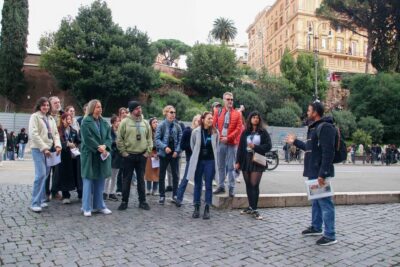
Colosseum & Forum with Audio Guide App -Optional Arena
Read our review →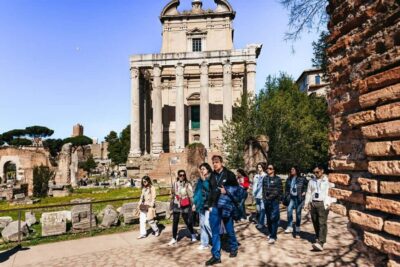
Colosseum, Forum & Palatine Hill Tour & Optional Arena
Read our review →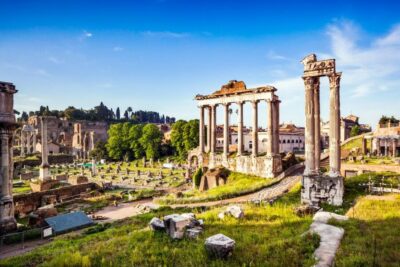
Colosseum, Roman Forum, Palatine with Multimedia Video
Read our review →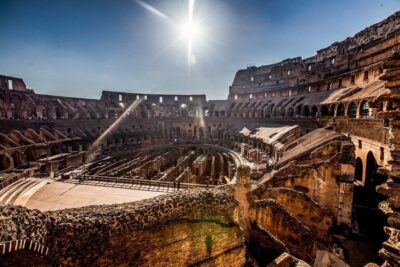
Colosseum: Underground and Ancient Rome Tour
Read our review →
Colosseum, Forum, Palatine Hill Entry & Audioguide App
Read our review →Browse the lists this tour appears in