
Review · ROME CATACOMBS TOURS
Rome: Catacombs of Domitilla Entry Ticket & Guided Tour
The Catacombs of Domitilla offer a rare look at Rome’s early Christian burial world, far below the level of its grand churches and ancient streets. The site’s network extends about 16 kilometers, but your short guided visit covers only an accessible portion, including chambers and a remarkable underground basilica.
I like two things here: the contrast between pagan and Christian imagery makes the site’s changing purpose visible, and the guide can explain why the burial place mattered to Christians. At $16, the ticket and guide are a useful pairing for a focused visit.
The main trade-off is time. Thirty minutes goes quickly, photography is not allowed, and reaching the catacombs at the appointed time can take planning, particularly by public transport.
- A cemetery that changed over time: Pagan burial spaces were later adapted and enlarged for Christian use.
- A two-level underground site: The catacombs are extensive, but only part is open to visitors on this tour.
- Frescoes with more than one tradition: You can see pagan and Christian imagery in the same burial complex.
- A basilica below ground: The shrine associated with martyrs Nereus and Achilleus became a small basilica in the fourth century.
- A small group: Tours are limited to 10 participants, giving you room to follow the guide and ask questions.
- A brisk visit: The tour lasts about 30 minutes, so it works best as one part of a larger day in Rome.
What the half-hour visit can show you
The Catacombs of Domitilla lie on Via delle Sette Chiese, in an area shaped by Rome’s early Christian burial grounds. The site began on land associated with Flavia Domitilla, who gave property to her freedmen. The story linked to her is striking: she was a Christian related to the imperial family, was exiled by Domitian to Ponza, and died there.
That background gives the place a human scale. These passages were not built as a showpiece for later generations. They formed part of a burial landscape used by people who wanted to lay their dead to rest in a sacred setting.
The full catacomb network is described as extending roughly 16 kilometers. That figure refers to the complex, not the distance you walk on this tour. Expect a guided look at a limited section, not a trek through the entire underground maze.
The short format has a clear benefit: you can see a distinctive piece of Rome’s history without giving up half a day. The drawback is that the visit is an introduction rather than an exhaustive exploration. If you want time to absorb every painted detail, the guide’s pace and the 30-minute limit may feel brisk.
Reading the walls: pagan and Christian art
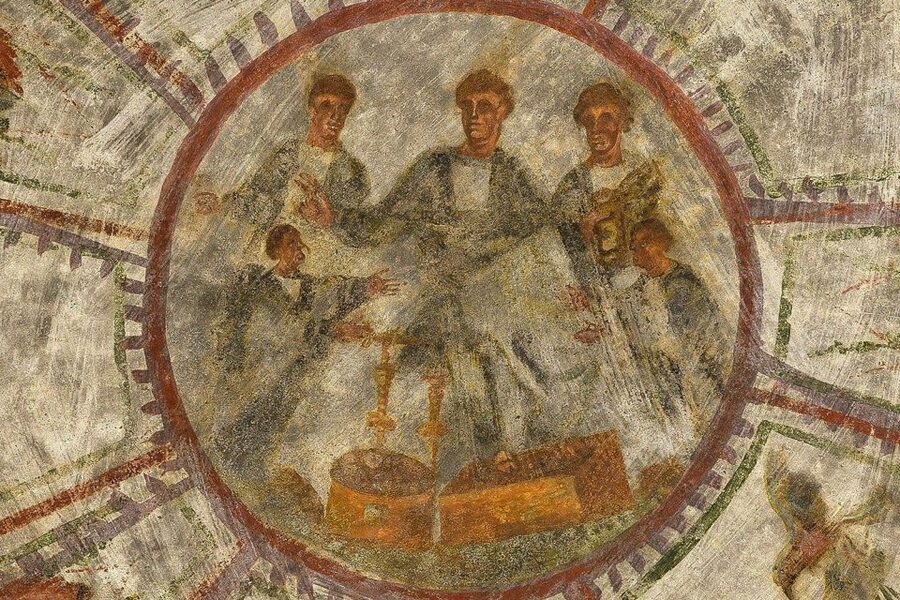
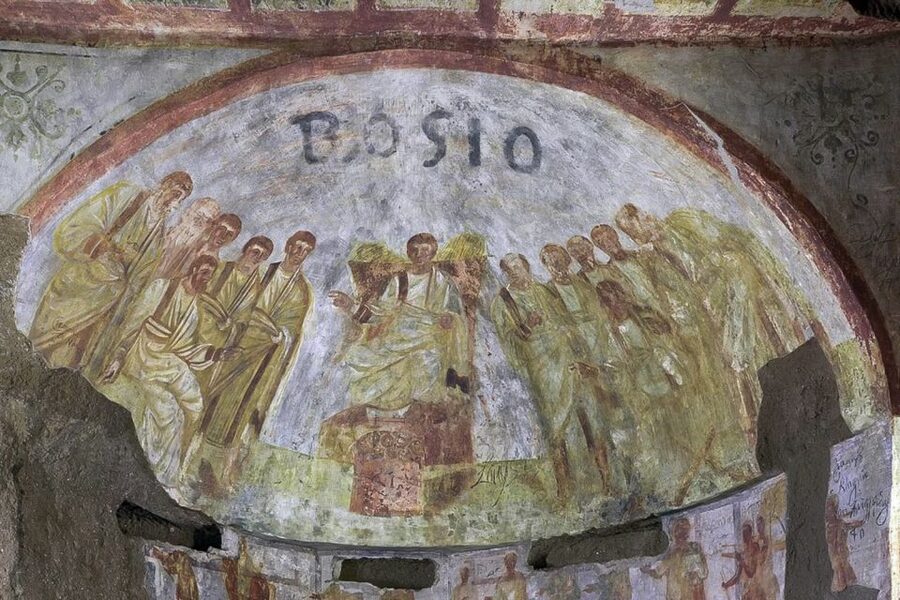
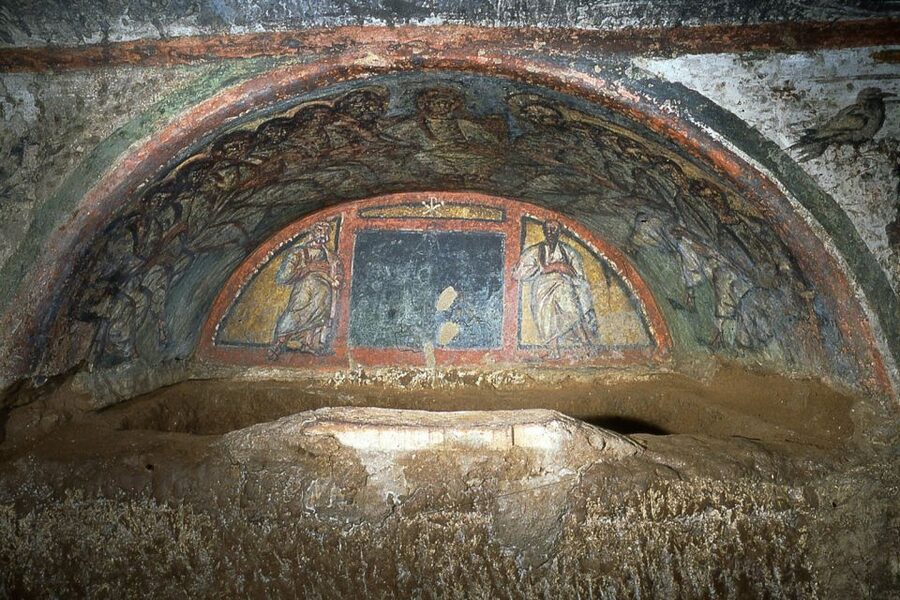
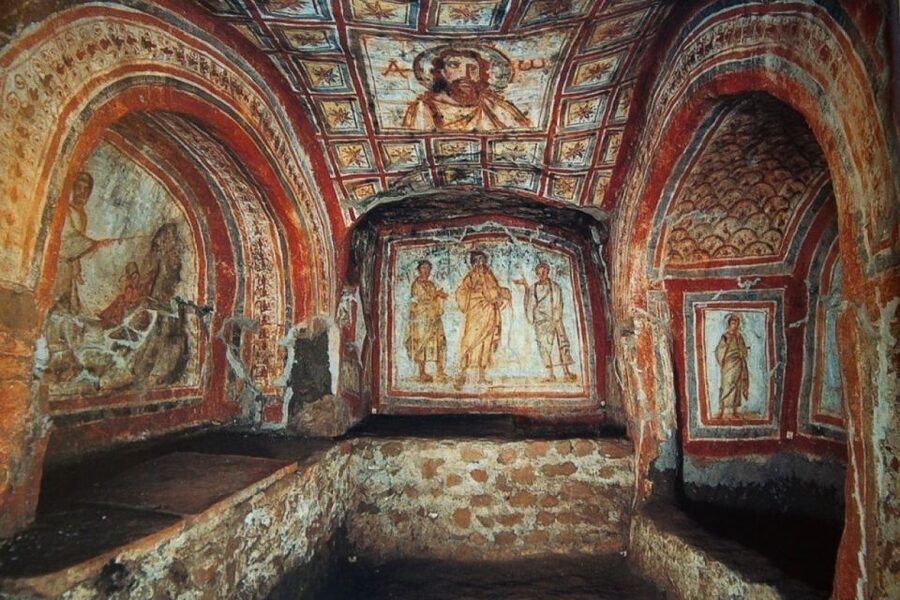
One of Domitilla’s most interesting features is its mixture of pagan and Christian frescoes. That blend helps you understand the site as a place that changed over time, rather than a complex that sprang into being with one fixed identity.
The so-called Hypogeum of the Flavians is a useful example. In the nineteenth century, archaeologist Giovanni Battista de Rossi believed he had identified tombs belonging to Christian members of Flavia Domitilla’s family. The space is now understood as a pagan hypogeum, dating from around the end of the second or beginning of the third century. It later became Christian and was enlarged in the middle of the third century.
Those changing uses are part of the appeal. You are not simply looking at old decoration; you are seeing how beliefs, burial customs, and the use of space shifted across generations. A guide can help you notice the difference between images and explain why the site’s early Christian character matters.
The frescoes also reward close attention, but the setting is not a gallery. You are underground, in a burial place, and the atmosphere is subdued. Photography is prohibited, so you cannot rely on a phone to preserve what you see. I’d pay attention as you go and let the guide’s explanations help fix the details in your memory.
More catacomb tours in Rome:
- Rome: Crypts and Catacombs Underground Tour with Transfers
★ 4.6 · 5,341 reviews - The Original Roman Crypts and Catacombs Tour with Transfers
★ 4.5 · 4,896 reviews - Rome: Catacombs of St. Callixtus Entry Ticket & Guided Tour
★ 4.6 · 3,037 reviews
The underground basilica and its martyrs
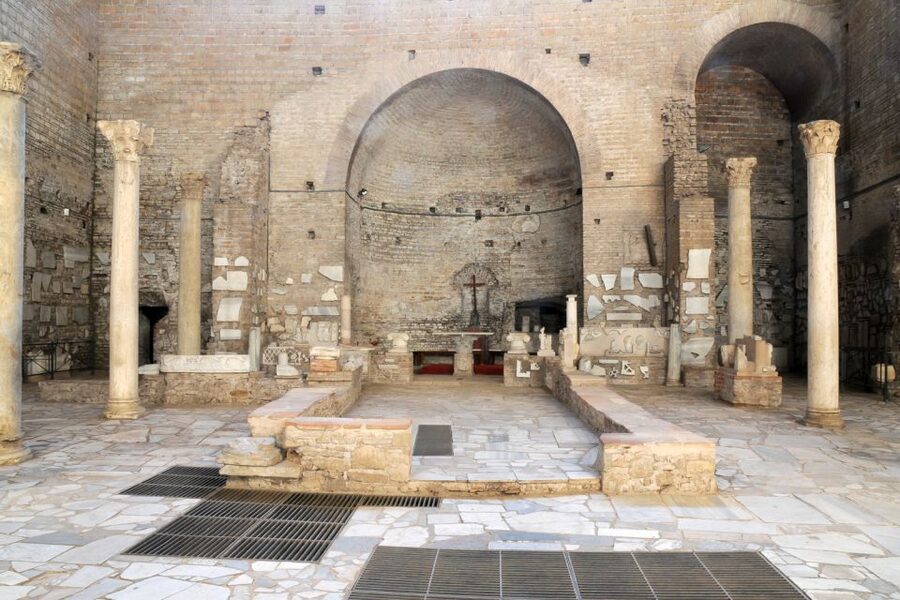
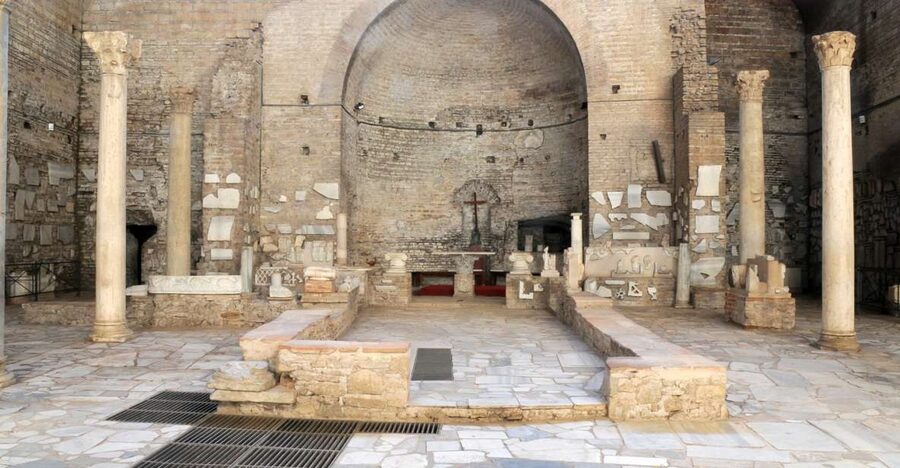
The most significant stop in the complex is the crypt associated with the martyrs Nereus and Achilleus. Toward the end of the third century, their remains were placed in a crypt on the second level. Pope Damasus transformed it into a small basilica between 366 and 384.
Pope Siricius later enlarged the building between 390 and 395, giving it the size it has today. That sequence makes the basilica more than an architectural curiosity. It reflects the growing importance of Christian worship and remembrance at a burial site.
For me, this is the part that best explains why Domitilla is worth visiting. The catacombs are not only a network of burial chambers; they also preserve a place where the dead were remembered and honored. The basilica gives that story a focal point, even if the short tour does not leave you long to linger.
A Polish-speaking visitor described Domitilla as the only catacombs with a basilica inside. That is a notable distinction, but keep your expectations grounded: the tour is brief, and the route covers only the section open to the public. You will get a glimpse of an unusual sacred space, not a full survey of the site.
How the guided route makes sense of the site
The visit begins at the catacomb ticket office. Show your reservation there at least 10 minutes before the scheduled start. From there, the guide leads the group into the underground area and explains the chambers and their history as you go.
The exact order of stops is not specified, so don’t expect a fixed sequence of named rooms. The experience is better understood as a guided introduction to the accessible portion of a large complex. You’ll hear about the site’s two main levels, the burial grounds, the frescoes, and the basilica linked to Nereus and Achilleus.
That guide matters. Underground passages can be hard to interpret on their own, especially when the decoration is fragmentary or the purpose of a chamber has changed over time. The most useful guides explain not only what you’re looking at, but how archaeologists have interpreted it and how the complex was adapted for Christian use.
The tour is limited to 10 people, a sensible size for a narrow, historic setting. A small group makes it easier to hear the guide and ask questions without turning the visit into a lecture hall. A guide named Andrea has led tours here, and visitors have also described guides who patiently answered questions and brought energy to the history. You cannot count on a particular guide, but the small format suits a site where explanation adds much of the value.
The tour is offered in Italian and English. Accounts of visits on particular dates also mention guides speaking German and Polish, but those languages are not among the stated regular options. If you need a language beyond Italian or English, check availability before booking rather than assuming it will be offered.
What the $16 ticket buys you
At $16 per person, the price includes both admission and a live guide. That is a fair value if you want the historical context and are already planning to visit the catacombs. The guide is especially useful here because the chambers and frescoes do not explain themselves, and the visit is too short for much trial-and-error wandering.
The price is less compelling if you expect a long tour or access to the entire 16-kilometer network. You are paying for a short, guided introduction to a restricted section, not an extended underground expedition. Think of it as a compact cultural stop, not the main event of a full day.
There is a practical value in the small group as well. With no more than 10 participants, the guide can address questions without competing with a crowd. That matters in a setting where you may want to ask about a fresco, the catacomb’s changing use, or the restoration work.
The tour has flexible booking terms: you can reserve now and pay later, and cancel up to 24 hours in advance for a full refund. Those options can help if your Rome schedule is still taking shape.
More tickets in Rome:
- Vatican: Museums & Sistine Chapel Entrance Ticket
★ 4.5 · 144,003 reviews - Rome: Pantheon Fast-Track Ticket and Official Audio Guide
★ 4.3 · 21,008 reviews - Rome:Hop-On Hop-Off Panoramic Open Bus Ticket 3 Circuits x 1
★ 4.0 · 15,405 reviews - Vatican Museums & Sistine Chapel Skip-the-Line Entry Ticket
★ 4.4 · 13,838 reviews
Getting there, dressing sensibly, and setting expectations
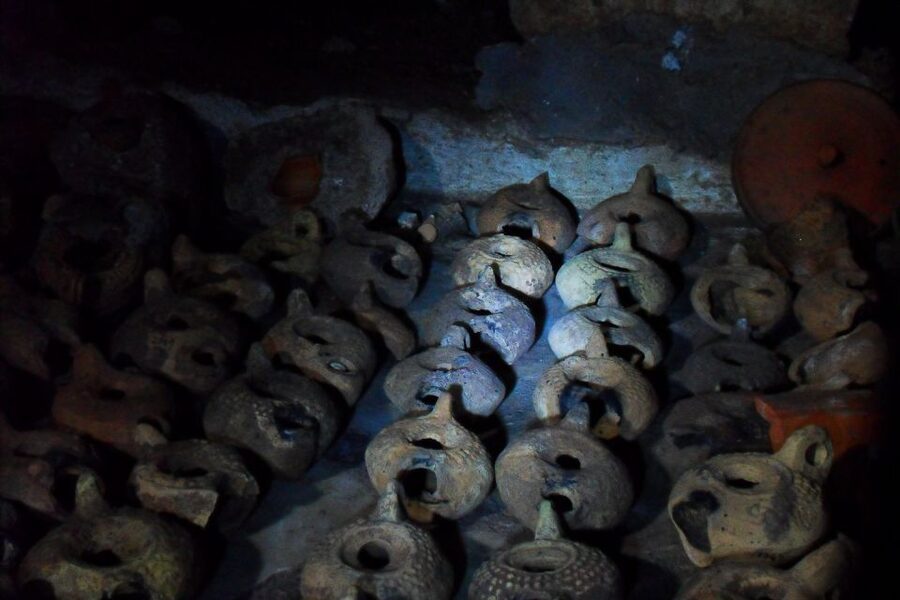
The meeting point is straightforward: go directly to the catacomb ticket office and show your reservation at least 10 minutes before the tour. Do not treat that as a suggestion to arrive at the last moment. One visitor found the set time difficult to reach by bus and train, so allow a generous margin if you are relying on public transport.
Comfortable clothes are recommended. The catacombs are underground, and the experience is defined by stone chambers and a cooler, enclosed setting. The supplied guidance does not specify a dress code or footwear requirement, so comfortable clothing is the practical advice to follow.
Photography is not allowed inside. If you like taking pictures as a way to remember a place, this restriction may be disappointing. Instead, listen closely to the guide and take note of the details that catch your attention once you are back outside.
The tour is not suitable for wheelchair users or people with mobility impairments. The underground setting and access limitations make this an important point to check before booking. If stairs or uneven access are a concern, this is not a tour to reserve on the assumption that the route can be adapted.
Who will get the most from Domitilla
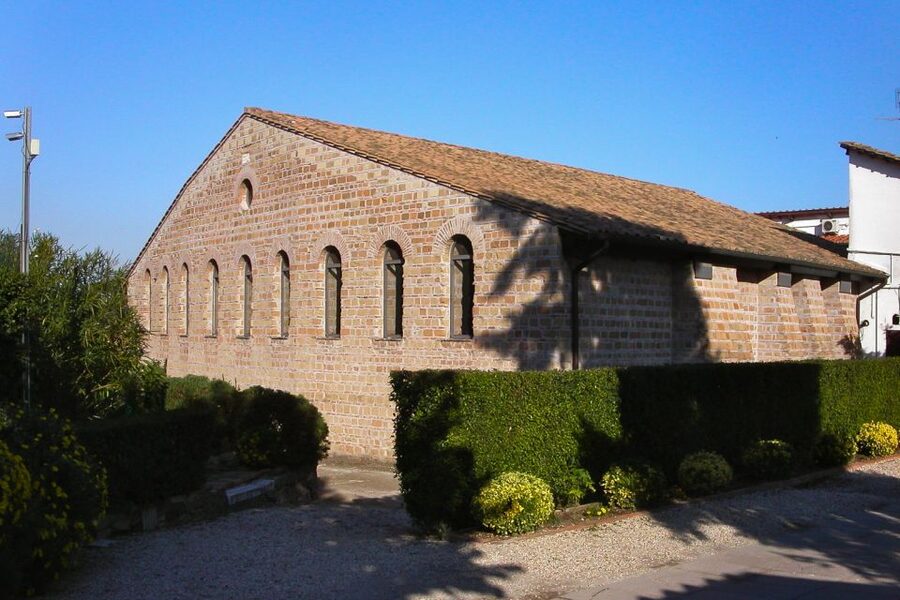
I’d recommend this tour to anyone curious about early Christianity, ancient burial customs, or the archaeology beneath Rome. It also suits visitors who want a short, focused activity rather than another long visit to a major monument. The site feels different from Rome’s open-air ruins: the emphasis here is on burial, memory, and sacred space.
It is a particularly good choice if you value a guide’s interpretation. A self-guided visit would leave you with chambers and images, but the explanations connect them to Flavia Domitilla, the site’s earlier pagan use, and the later Christian basilica.
Families with older children who can manage the underground setting may find the visit memorable, though the tour’s brief length and serious subject matter are worth considering. The information provided does not specify a minimum age, so check directly if you have a young child and need age guidance.
This is not the right pick if you need step-free access, want to take photographs, or expect an expansive tour through the whole network. It is also less suitable if your schedule is so tight that you cannot allow extra time to reach the meeting point.
Should you book this tour?
Book it if you want a compact, guided look at an unusual part of Rome: a sprawling cemetery, a mix of pagan and Christian art, and an underground basilica tied to early martyrs. At $16, admission and a small-group guide make good sense for a 30-minute visit, especially if the history is what draws you.
Skip it if the short duration, restricted route, no-photo rule, or access limitations would frustrate you. The best reason to go is not the promise of seeing every corridor. It is the chance to understand how one underground burial complex changed across centuries, with a guide to help you read the evidence.
FAQ
How long is the Catacombs of Domitilla tour?
The guided tour lasts about 30 minutes.
How much does the ticket cost?
The price is $16 per person.
Which languages are available?
The stated tour languages are Italian and English. German and Polish have been reported on specific dates, but they are not listed as regular options.
How large is the tour group?
The small group is limited to 10 participants.
What is included in the price?
The ticket includes entrance fees and a tour guide.
Where do I meet the guide?
Go directly to the Catacomb ticket office and show your reservation.
How early should I arrive?
Arrive at least 10 minutes before the scheduled tour.
Can I take photographs inside?
No. Photography is not allowed inside the catacombs.
Is the tour accessible to wheelchair users?
No. The tour is not suitable for wheelchair users or people with mobility impairments.
What should I wear?
Comfortable clothes are recommended.
Newly reviewed in Rome
- Rome: Neapolitan Pizza Cooking Class in Front of the Vatican★ 4.8 · 137 reviews
- Rome: St. Paul’s Within the Walls New Year’s Concert Ticket★ 4.4 · 35 reviews
- Rome: Navona Underground & Domitian Stadium Guided Tour★ 4.6 · 36 reviews
- Rome: Navona Square and École Française Underground ticket★ 3.9 · 160 reviews
- Rome: Monuments and Belvederes Bike Tour★ 4.7 · 26 reviews
- Rome: Musical Biography of Frank Sinatra Concert★ 3.9 · 100 reviews
- Rome: Monti Neighborhood Lunch or Dinner Food Tour★ 4.9 · 8 reviews
- Rome: Mini hike to the ancient Parco degli Acquedotti★ 4.9 · 9 reviews
Rome Catacombs Tours, compared.

Crypts and Catacombs Underground Tour with Transfers
Read our review →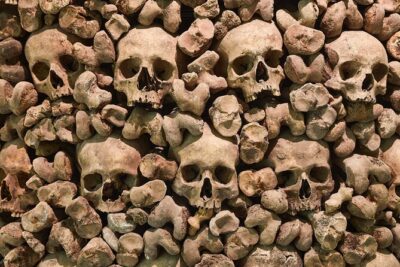
The Original Roman Crypts and Catacombs Tour with Transfers
Read our review →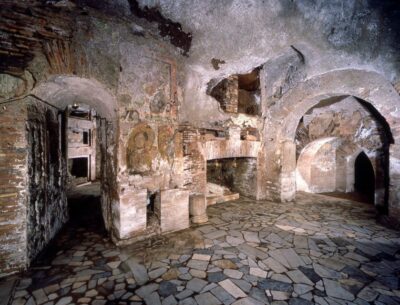
Catacombs of St. Callixtus Entry Ticket & Guided Tour
Read our review →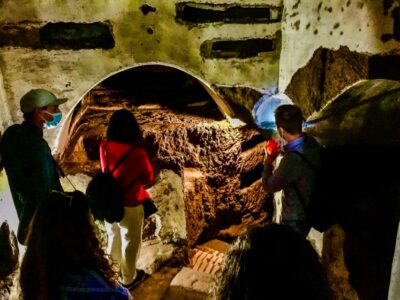

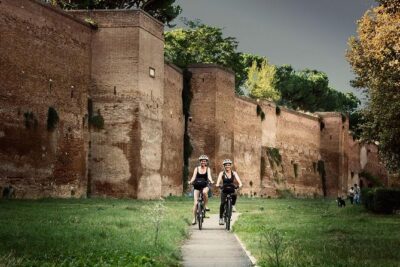
Rome EBike Tour: Appian Way, Catacombs & Roman Aqueducts
Read our review →
Catacombs and Capuchin Crypt Guided Tour with Transfer
Read our review →
St. Peter’s Basilica Priority Access Tour with Dome & Crypt
Read our review →Browse the lists this tour appears in